


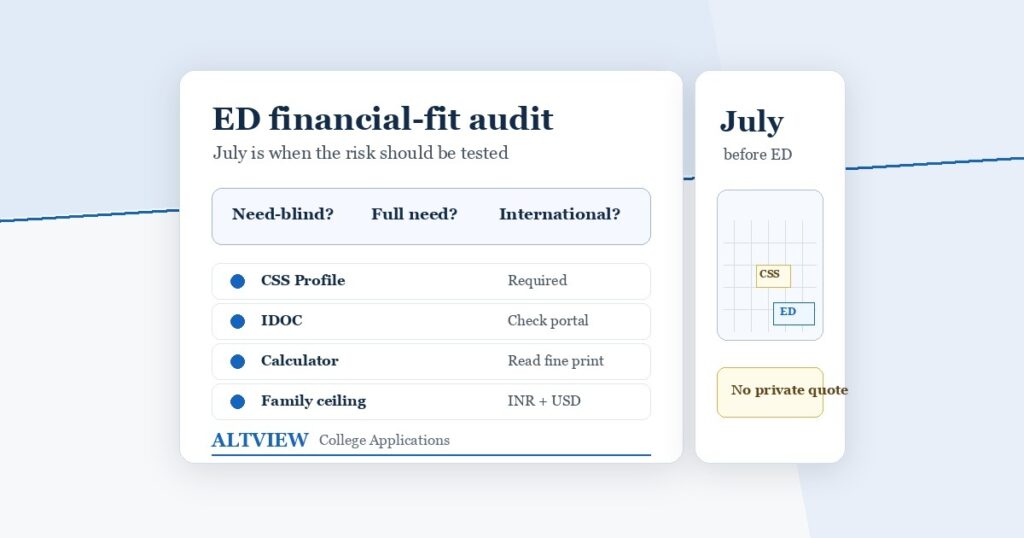
July is already crowded for a Class 12 family: essays, SAT dates, school exams, and the college list.
The good folks at Higher Ed Insights recently wrote about why CSS Profile planning needs to start earlier than many families expect. It prompted me to think about how the same issue plays out for Indian families, especially when Early Decision is involved.
If the student is considering Early Decision in the US and the family will need institutional aid, July also needs a serious conversation about money. The CSS Profile form opens later, but families need an approximate budget before they choose a binding application. At many colleges, the first school-calculated number arrives with the admission decision.
In December, the admit and the aid award often arrive together. By then, everyone has started celebrating and other early plans have been set aside.
If the number is unaffordable, the family can discuss it with the college and may be released from the ED commitment. A family should not enter ED expecting to rely on that release. In July, there is time to choose a different early plan.
What “gives aid” can mean
Families usually ask, “Does this college give aid?” An international applicant needs answers to four separate questions:
- Does asking for aid affect the admission decision?
- If the student is admitted, does the college say it will meet full demonstrated need?
- Does that policy include international students, or only domestic students?
- How will the college calculate what this family can pay?
Depending on the answers, the college list can change quite a bit. Some private colleges ignore financial need during admission and meet the full calculated need of every admitted international student. Others consider need when choosing the class, even if they offer strong aid to the international students they admit. At many public universities, families will be looking mainly at merit scholarships.
College websites make it easy to stop at a reassuring phrase such as “need-blind” or “meets full demonstrated need.” The college still calculates what it believes the family can contribute, using its own method. That number may be quite different from what the family feels comfortable paying.
Need-blind, need-aware, and full need are different things
Need-blind admission means the college says it does not consider the student’s financial need when making the admission decision.
Need-aware, or need-sensitive, admission means the college may consider the family’s need for aid as part of the admission process. For international applicants, limited institutional-aid budgets can make that part of the admissions decision, and most cannot access US federal aid.
When a college says it meets full demonstrated need, it is promising to cover the gap between its cost of attendance and its own calculation of the family’s contribution.
For an Indian family, the calculation may include salary, savings, property, rental income, capital gains, business ownership, and support from relatives. Separated parents create another set of questions. Meanwhile, the family is budgeting in rupees and thinking about home loans, school fees, elder care, business cash flow, and four years of dollar payments. A college may view the same finances differently from the family.
The resulting family contribution can sit well above the family’s budget even when the college has followed its published policy.
Even generous colleges need careful reading
The group is larger than the three or four names many families remember. I checked the official pages in July 2026. Harvard, Yale, Princeton, MIT, Amherst, Dartmouth, Bowdoin, Brown, Notre Dame, and Washington and Lee all say financial need does not affect first-year admission for international applicants and that they meet full demonstrated need for admitted students. Brown’s policy began with the Class of 2029. Transfer, waitlist, and aid-application rules can differ, so families should check the page that applies to their own application round.
Families still need their own estimate. Some colleges publish examples showing that families below a certain income pay no tuition or very little. The examples may assume typical assets, US residency, one child in college, or a particular calculator methodology. An Indian family’s finances may sit well outside those assumptions.
Princeton’s cost-and-aid page, for example, says its income table is based on US-resident families with assets below a stated level and one child enrolled in college. Its net price calculator says it is designed for families in the United States and Canada and will not provide accurate results for families living elsewhere.
Princeton offers substantial aid to admitted international students. Its public examples, though, are not personal estimates for a family earning in rupees, holding property or business assets in India, and planning for four years of dollar costs.
CSS Profile, FAFSA, and IDOC
FAFSA is mainly for US citizens and eligible noncitizens applying for US federal aid. Most Indian international applicants will not use it for their main aid case.
Many colleges and scholarship programs use CSS Profile to award their own institutional aid. The College Board says international families can report financial information in their home currency.
The home-currency option helps, although the form may ask for more detail than families expect. Income, assets, expenses, business information, tax documents, and parent details can all become relevant. Some colleges require information from a noncustodial parent. Others request documents through IDOC, where the deadlines and required records appear after the student signs in. It is worth finding out what will be needed while there is time to collect and explain the records.
Why Early Decision changes the timing
For Regular Decision, families still need to consider affordability, but the pressure to decide is different. The student may have multiple offers and aid packages to compare. Early Decision changes the emotional sequence. The family is making a serious commitment before seeing the final aid award.
If the aid award is genuinely unaffordable, colleges generally do not want to force a family into an impossible situation. Families do sometimes ask to be released. Planning the likely cost before applying reduces the chance of reaching that point.
In July, the family has room to adjust the list and decide whether ED is sensible. It can compare a high-aid reach with need-aware colleges, merit-aid possibilities, public universities, or a mixed-country plan. By October, the student’s work on a specific early application can make changing direction feel much more costly.
Explaining Indian income and assets
For a salaried family with standard documents, the process may be fairly straightforward. Business or professional income, partnership holdings, multiple properties, agricultural land, family-company assets, and irregular capital gains usually require more explanation.
Separated or divorced parents can add another layer. Extended-family support can be real but hard to explain. Currency movement can change how a four-year plan feels. A family may be able to pay a certain amount once, but not safely every year.
Indian families should apply for aid when they need it, with a clear view of how much uncertainty remains before the student builds an ED plan around one college.
A July financial-fit check
For every serious ED possibility, build a small financial-fit sheet.
- Is the college need-blind or need-aware for international applicants?
- Does it say it meets full demonstrated need for international students?
- Does it require CSS Profile, its own aid form, IDOC, or noncustodial parent information?
- What is the earliest financial-aid deadline for early applicants?
- Does the net price calculator work for international families, or is it domestic-only?
- Are any published income examples based on typical assets or residency assumptions?
- What is the family’s real annual affordability ceiling in rupees and dollars?
- If the college calculates a higher family contribution, would the family still be able to proceed?
- If not, is ED still a sensible plan?
Put the answers in writing. A number agreed verbally in July can start moving once essays, school deadlines, tests, and parent-student emotions enter the room.
What this changes in the college list
Once the family does this audit, a generous college may remain the ED choice. If the estimate is too uncertain, the same college can move to Regular Decision so the family can compare offers. Colleges whose likely cost exceeds the family’s ceiling can come off the list. Merit-aid options may need a separate place on it.
Removing a college over cost can be disappointing. It is usually easier to handle in July than beside a December admission offer.
Before you settle on Early Decision
ED can make sense for the right student and college. Before choosing it, work out how the college is likely to read the family’s finances and what annual contribution the family can sustain for four years.
If the family cannot answer yet, keep the college under consideration but wait before making it the binding choice. Run the financial-fit audit while the list is still flexible.
At AltView, we work through these questions while the list is still flexible. We look at the college’s aid policy and forms, what the family can sustain, and whether ED still makes sense.
You can book a discovery call with us if you want help pressure-testing the plan.