


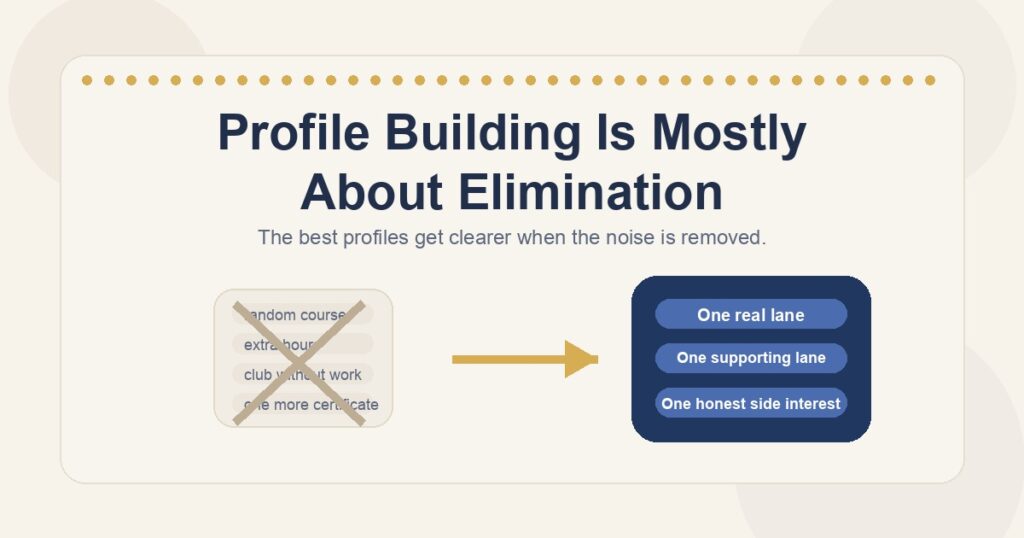
Parents often come in asking what else their child should add to the profile. Another course, another activity, another competition, something more. More often than not, I end up pushing in the other direction.
That question usually comes from the same place. By Class 9 or 10, the calendar is starting to fill up. There is some school activity, maybe a competition or two, maybe a summer program, maybe a course somebody recommended, maybe community service because another parent mentioned it. At some point families look at all of this and think: is this enough, is this the right mix, and are we already behind?
That anxiety makes sense. It is also where a lot of bad profile building starts.
Why this happens
US admissions in particular creates this problem because it is so easy to overread from the outside. Nobody tells you exactly what matters. So families do what people usually do when the rules are unclear. They add more. One person says research helps. Someone else says leadership. Then Olympiads, then public speaking, then an internship, then a fundraiser, then some online course no one really cares about except that it can be listed somewhere.
After a while the child is busy, but not necessarily clearer.
That is why I keep coming back to the same view: most profile building is really an exercise in elimination.
I don’t mean that children should be narrowed too early. A student in Class 8 or 9 should absolutely try things. That is how they discover what feels natural, what feels dead, and what only sounded impressive when an adult suggested it. Exploration is useful. Sometimes it is the most useful thing happening.
But exploration and accumulation are not the same thing.
The trouble starts when families stop experimenting and start hoarding. A student joins debate and likes it. Good. Then a few months later somebody adds an NGO role. Then a half-serious research project. Then a certificate course. Then a competition that has nothing to do with the rest of the profile but looks selective enough that nobody wants to say no.
Now imagine trying to understand that student from the outside. What are they actually drawn to? What do they return to when nobody is pushing them? What has become deeper over time? Very often, the profile doesn’t answer those questions. It just shows activity.
That is where families get frustrated. They’ve spent time, money, weekends, and a lot of mental energy. The child has objectively done many things. But the picture is still muddy.
The wrong activity can blur the whole picture
One reason this happens is that people assume the downside of a weak activity is only that it doesn’t help very much. I don’t think that’s quite right. The wrong activity can blur the whole picture. A generic service initiative, a leadership title with no real substance behind it, a random pile of courses, a project the student can’t explain without sounding coached, these don’t just sit there harmlessly. They compete for attention with the parts that are actually real.
And that is the part I think gets missed.
If a student genuinely likes history, or math, or music, or design, or coding, or debate, then over time that should become easier to see. Instead, many profiles become harder to read because the real interests are buried under too many strategic additions. Families think they are strengthening the story. Often they are just making it noisier.
This is where the breadth versus depth conversation usually begins, and I understand why. The phrase is everywhere. But I don’t think that is the first question to ask.
The first question is usually much plainer: what can we stop?
What is there because the student actually cares about it? What is there because someone once said it would be useful? What belongs in the center of the profile, and what is just hanging around because nobody has had the heart to drop it?
Those questions tend to be more revealing than “how much breadth do we need?”
Once you start there, depth becomes easier to build. Not because someone gave you a framework, but because the child suddenly has time and attention again. A student who is pulled in six unrelated directions rarely develops real depth in any of them. A student who has one or two areas that remain after the noise has been cleared away usually starts to look much more convincing, and more importantly, much more like themselves.
What this means for a US-bound profile
This confusion shows up most strongly with US applications because families know, broadly, that extracurriculars matter. That part is true. But from there, many people make a bad jump. They hear that the US wants more than marks, and they conclude that the child should simply do more things.
That is usually where the profile starts getting worse instead of better.
US admissions usually does not reward random variety for its own sake. It responds much better to seriousness, continuity, and evidence that the student’s interests are actually lived rather than assembled. A smaller number of real commitments usually carries more weight than a long list of thin ones, especially when the longer list starts to look supervised, strategic, or borrowed from someone else’s idea of a good applicant.
The question I keep coming back to
When I am trying to sort this out with a family, I keep returning to one question:
If college admissions disappeared tomorrow, would this student still do some version of this?
Not necessarily in the same form. Not with the same intensity. But some version of it.
That sounds simple, but it clears up more than most elaborate strategy sessions. Usually the answer tells you what deserves to stay, what needs to go, and what should stop pretending to be important. It also tells you something else that matters: whether the activity belongs to the student, or to the admissions ecosystem around the student.
So yes, depth matters. But if the profile is already cluttered, that is not where I would begin. I would begin by making the whole thing easier to read.
That means removing noise until the student can actually be seen again.
Need help figuring out what to stop?
That is often the real counseling job. Not telling families to do more, but helping them see what is real, what is optional, and what is just noise. If you want to think this through properly for your child, the best place to start is an AltView Deep Session.