


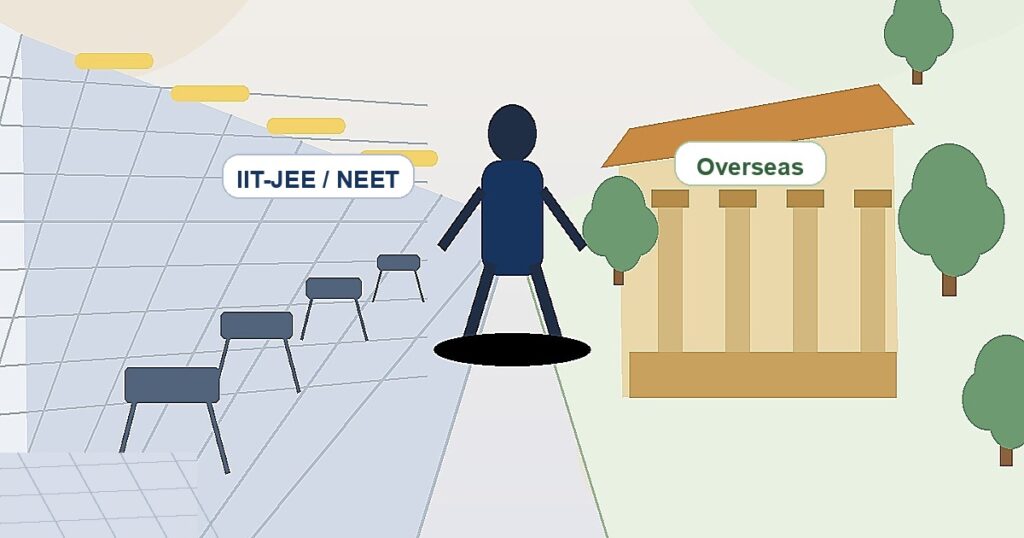
A parent asked me a version of this recently.
Her son is in Class 11. He is strong in math and physics. The family is interested in US and UK options, but they also do not want to close the door on IIT too early.
So the plan is familiar: continue JEE coaching seriously, keep school marks high, prepare for the SAT, build activities, explore majors, and somehow leave enough space for essays later.
I do not dismiss that plan. But I would not accept it at face value either.
I understand why Indian parents think this way. IIT-JEE and NEET are known systems. The path is hard, but visible. There are ranks, coaching centres, test series, cutoffs, and a clear sense of what effort is supposed to look like. A parent can track progress.
The overseas admissions process feels less visible. A strong student can still be rejected. A student whose strengths show up differently may do better than expected because the fit, essays, recommendations, and institutional context work differently. There is no single rank or cutoff that decides the whole outcome.
So keeping both tracks alive can feel like a responsible hedge. If overseas admissions do not work out, IIT or medicine in India is still there. If the overseas admit is strong, the family can choose later.
I understand the logic. My hesitation is more practical: families often underestimate what this hedge asks from the student.
What dilution looks like in real life
Serious JEE or NEET preparation expands quickly. A student in a serious JEE batch at Allen, VMC, or a comparable coaching centre is already carrying a near-full academic load. Classes, doubt sessions, test series, revision cycles, school exams, board preparation, travel time, and fatigue take up more space than families expect.
The overseas track also takes time, but the work looks less visible. A student needs to explore subjects, build a sensible college list, prepare for the SAT or ACT if needed, plan for APs and other country-specific tests such as TMUA, understand country-specific differences, request recommendations, draft and revise essays, and make choices about activities.
A lot of this work looks ordinary from the outside. Reading, talking, thinking, deciding. It does not give the same immediate proof of effort as a coaching test score.
So the overseas work gets postponed.
The family says, “Let us finish this test series first.”
Then, “Let us wait until school exams are over.”
Then, “Let us start essays after the next mock.”
By the time the student turns properly to applications, the calendar is full, and the student is tired. The essay has to be built from whatever material is already lying around, because there has been no time for real discovery.
I see this often. Sometimes the student has worked very hard and even done reasonably well in coaching. The overseas application still ends up generic because there was no bandwidth left to think about who the student is, what they want, and why a particular academic path makes sense.
When parallel preparation can work
Some students can carry both tracks for a while.
They usually have a few things going for them. They are genuinely strong in the relevant subjects. They do not need constant external pressure to study. Their school workload is manageable enough. They can handle coaching ranks without letting those ranks become their whole self-image. Their overseas direction is also reasonably clear; they know roughly what they are aiming for and why.
For these students, JEE-style preparation can genuinely help. Deep problem-solving in math and physics can support AP Calculus, AP Physics, Olympiad-style thinking, or first-year university coursework. The discipline of sustained preparation can also help a student understand whether they actually enjoy the subject under pressure.
NEET preparation can build real depth in biology and chemistry, too. But medicine abroad is much more complicated than many families first realize. The route depends heavily on the country, degree structure, cost, licensing pathway, and long-term plans. It should not be treated as a simple extension of NEET preparation.
Some of it does overlap. I just think families often overestimate how much of JEE or NEET preparation transfers into a strong overseas application.
What is the coaching actually for?
I wish more families asked this earlier.
The word “coaching” can hide two different choices.
One choice is targeted academic strengthening. A student applying abroad for engineering may use some JEE-style math or physics practice to strengthen their skills in these subjects.
For the right student, that can help. The family may decide that some coaching, a strong board performance, APs, and independent subject exploration all support the same direction.
The full JEE competition demands a different kind of commitment. A serious coaching environment teaches content, but it also ranks the student, paces the student, assigns the next test, and pulls the student into a world where the benchmark is a national entrance exam.
For a student who genuinely wants IIT as a first-choice outcome, that may be the right environment.
I would be much more cautious when the student is carrying the race’s workload without wanting the result.
I have seen students in this position. The coaching centre assigns the work. The test series produces a rank. The student absorbs the pressure. Meanwhile, the overseas application, which is supposedly the preferred path, gets whatever is left over.
At that point, the family may still call it a balanced plan. In reality, the default setting has already become very demanding, and the student is carrying the uncertainty.
What rank comparison can do
I also worry about what two years of rank comparison can do to a student’s self-image.
Many bright students spend two years in coaching environments where their self-image becomes tied to rank and percentile rankings. Some handle that environment well. Others carry the comparison into the application process.
A student who is perfectly capable of doing well at a strong US or UK university can start feeling mediocre because they are ranked far below the very top of a coaching batch. The daily comparison changes how they see themselves. When essays begin, they may write from a defensive place, as if they first need to prove they are not a failure.
The opposite distortion also happens. A student doing well in coaching may assume that strong exam performance automatically becomes a strong overseas application. It does not. The SAT or ACT is different. Essays are different. Recommendations are a different kind of evidence. A student can be excellent at solving coaching worksheets and still have no clear story to tell an admissions reader.
Questions to ask before committing to both
If a family is trying to decide whether to keep both tracks alive, I would begin with a few honest questions.
First, if both paths worked out, which would the student choose?
If the answer is clear, the calendar should reflect it. If the answer is fuzzy, the family needs that conversation before adding more coaching hours.
Second, what would have to shrink?
If the student is spending twenty hours a week on coaching and test series, what disappears? Reading outside the syllabus? Unstructured time? Essay thinking? Sleep? The chance to explore a subject because it is interesting rather than because it is tested?
Sometimes the tradeoff is worth it. Often, once a family names the trade-off clearly, the plan starts to look less sensible.
Third, is there a primary direction?
A student can spend Class 11 and 12 doing an enormous amount of work while moving in no clear direction. The coaching centre assigns work. The school assigns work. Everyone is busy. Everyone feels productive.
But when application season arrives, the student may still not know what they want to study, where they are applying, what their essays should say, or why their profile makes sense.
By October of Class 12, that is a hard problem to solve.
What I would tell each class
For Class 9 and 10 families, I would not rush into a full coaching identity unless the student is genuinely headed that way. This is still a good time to explore. If the student enjoys math, physics, biology, or chemistry, some structured practice can help. But the student also needs time to read, try things, meet people, build, write, and notice what they actually care about. Overseas applications eventually need that raw material.
For Class 11 families, the plan needs a primary direction. It is fine to keep a secondary option alive, but the calendar should not lie. If JEE or NEET is the main plan, build around it and keep overseas options realistic. If overseas is the main plan, academic preparation should support that path rather than quietly consume the student’s life.
For Class 12 families already in the middle of both, I would triage. If the student is deep in coaching and the overseas application is thin, something has to give. The answer may be a narrower college list, a more realistic country strategy, a reduced testing plan, or a decision to stop pretending every option is equally alive. The essay cannot be written from the leftover fragments of a coaching schedule.
A practical next step
If your family is weighing this, I would start with one conversation before adding another class, test, or college list.
Ask what the student would actually choose if both options worked out. Then look at the weekly calendar and see whether it matches that answer.
For some students, the honest plan will be JEE or NEET first, with a limited overseas track. For others, it will be overseas first, with strong boards, testing, APs where useful, and targeted subject depth. For a few exceptional students, both can run together for some time, but only with clear checkpoints and real support.
The version I worry about most is the one where nobody chooses. Full coaching continues; overseas applications are still expected to proceed seriously, and the student is expected to bear the cost of the family’s uncertainty.
If your family is trying to decide whether JEE, NEET, and overseas applications can realistically run in parallel, book a discovery call with us. We would rather have that conversation early, before the calendar starts making the decision for you.