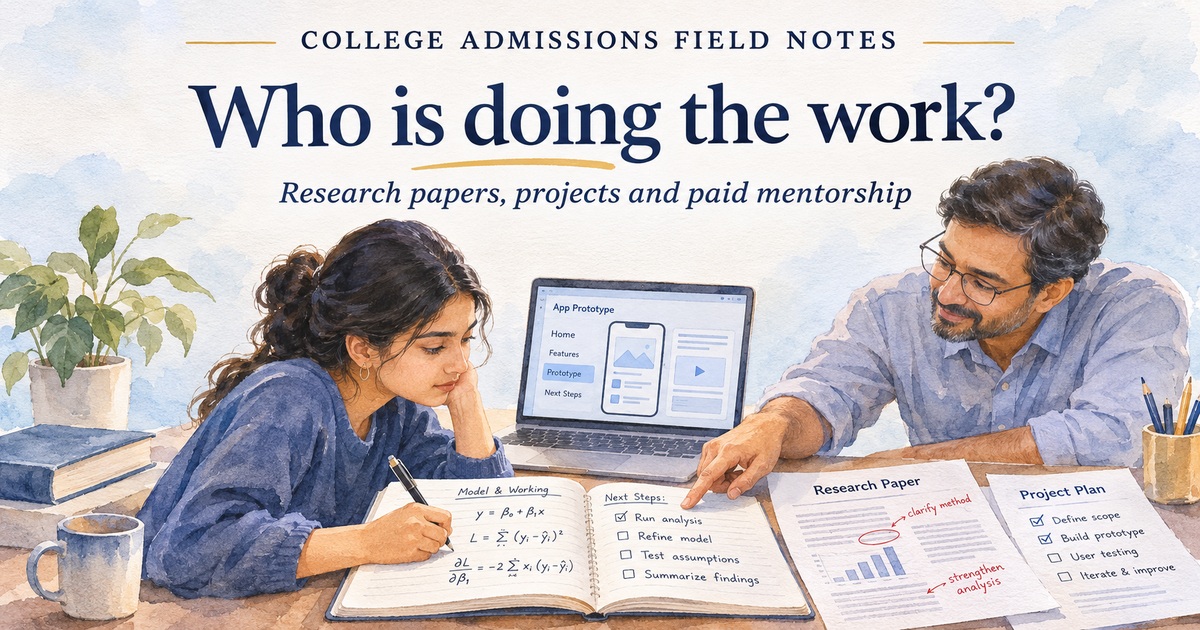
Almost all of my students have found research mentors. So when parents ask me about paid research programmes, I usually suggest they try finding a mentor first on their own. It’s my personal favourite, low-cost option, and I think more families should give it a go.
Start with people you know. Ask friends if they know someone who works in the subject your child wants to explore. Your child can also look through faculty pages at colleges and universities, read the professors’ bios and find their email addresses. They should spend a little time reading about the person’s work before writing to them.
Then let your child send the email. A short introduction, what they’re interested in, and why they chose to write to this professor is enough to get started. They can mention something they’ve already read or tried and ask if the professor would be willing to guide a small project. If they’re in Class 10 and just beginning to explore the subject, they can say so. You only need one person willing to help, and you might be surprised by the responses.
Once someone agrees, work out what your child can attempt and how often the professor has time to speak with them. Ask about any costs or arrangements needed to use a lab. The first project can be small. A student interested in economics could learn to analyse some public data, while another might start by reading a few papers and discussing them with the professor. They’ll have a better idea of what they need help with after trying.
But if you can’t find someone to mentor your child this way, there are paid programmes for research papers, apps and other projects. I personally don’t prefer them, though sometimes they can be useful. Before paying, though, you should know how much of the work your child will actually do. You can look at a polished paper or an impressive app and still have no idea of the child’s actual contribution to it.
We touched on this in the previous post about what these experiences add to an application. Here, you have a chance to ask about the work before signing up. Read the previous post.
What does the fee cover?
If you’re considering a paid programme, ask what the mentor will actually do. How will they help your child choose a project and learn the methods needed? Who will read the work and give feedback between meetings? Get those details before comparing fees.
Research programmes give us a couple of examples of how these services are packaged. Polygence’s FAQ lists programmes starting at approximately US$3,000, apart from its lower-priced group courses. Its Core programme has ten one-hour sessions over three to six months, with writing feedback. Lumiere’s programme comparison lists nine mentor sessions and two writing-coach sessions for its twelve-week Individual Research Programme; its publication-oriented options add further support. Those are the services listed by the providers in November 2026. You still need to judge whether the teaching will suit your child.
When comparing quotes, look at the actual time your child will spend with the mentor. A programme can run for twelve weeks and include only a handful of meetings. Ask how much individual time is included, who reads the work between meetings, and what happens if the student needs longer to understand a method. You should also get a total cost that includes any submission support and additional fees. Ask who the mentor will be and how they work with beginners. A university name on their bio leaves a lot of that unanswered.
How much of the work will your child actually do?
Suppose a student interested in economics wants to understand why inflation affects some families more than others. A mentor could help them compare two hypothetical household budgets, one where most of the money goes on essentials such as food and rent, and another with more room for holidays and eating out. The student uses published price data to calculate how much each household’s expenses would rise. They then have to explain why the same headline inflation rate can mean quite different things for these families.
The mentor can help them choose suitable data and check their calculations. The student still has to decide how to divide up the budgets and explain how those choices affect the results. If the mentor supplies both budgets, does the calculations and writes the explanation, I’d be uncomfortable describing the result as the student’s independent research.
A beginner will need help with this. But they should be able to explain why they chose those budgets and what happens if they change an assumption, such as how much a family spends on rent. When a provider shows you a sample paper, ask what the student worked out and where the mentor stepped in.
Take the app example. Suppose your child wants to build a sign-up tool for their school club. The mentor can show them how a form saves a response, then ask them to work out what should happen when someone signs up twice. Your child might try a fix and test it with a few club members. If the mentor builds the sign-up system between calls and the student mostly edits the screens, the result may look better on demo day. You’d want to know that difference before agreeing to pay, especially if the brochure shows you only the finished demo.
You can often learn more from asking what happens when a student gets stuck than from looking at a portfolio of finished projects. For a beginner, I’d be happy with a small app they can change themselves or a modest analysis they can explain. Ask what the mentor will do if the project turns out to be too ambitious. A good answer might involve cutting the scope so the student still has time to work through the difficult bits.
What about publishing?
“Help with publication” can mean feedback on a manuscript and support submitting it to a journal. It can also leave parents expecting acceptance for publishing when that was never promised. Read the wording carefully. Lumiere explicitly says publication cannot be promised by an academically rigorous programme. Polygence likewise says it does not guarantee peer-reviewed publication. If someone sounds more certain about publication on a sales call, ask them to explain how that fits with the written terms. Lumiere · Polygence
You also need to know where the work would appear. A project hosted on a programme’s website, a manuscript uploaded to an archive and an article accepted after external peer review should not all be described as though they went through the same scrutiny. A student journal can provide a worthwhile introduction to revision and publication, but you still need to examine its standards and describe the outcome accurately.
The Think. Check. Submit. journal checklist is a useful starting point. It asks about the publisher’s identity, independent review, fees and how the work is preserved and made discoverable. It also flags guaranteed acceptance or very short peer-review times. You do not need to become an expert in academic publishing, but you can ask the mentor to walk you through these checks for the proposed journal. Some credible journals charge fees too, so you need to look at how they review and publish the work.
Also ask whether the programme owns the journal or has a commercial relationship with it. You should know who is deciding to accept the paper and what connection they have to the people you’re paying. And if someone offers a publication guarantee, ask exactly what is guaranteed, where, and who makes the acceptance decision. If the answers remain vague, I would stop there.
What would your child get out of it?
Before enrolling, talk to your child about what they want help with. Perhaps they’ve built something but don’t know how to test it with other people. Or they’ve found data they want to use and don’t know where to start. You can take that to a mentor and ask how they would help, and what your child would need to do between meetings.
If you would feel the money was wasted unless a paper got published, I’d reconsider. Your child could learn a lot and still have their paper turned down. Would you be happy with what they got out of the programme then? That’s a conversation worth having before you pay.
There is no need to assume that unfinished work is unusable in an application. For example, Caltech’s research submission process includes work that is published, submitted or in preparation, subject to its criteria. It asks how the experience was obtained and requires a recommendation addressing the student’s specific contribution. Some projects belong in its portfolio route instead. Check the rules at the universities on your child’s list before deciding they need to rush a paper into publication.
We’ll look at more affordable options in the next post. For now, if you’re comparing paid programmes, ask what happens in a typical week. What does your child attempt before the next meeting? Who reads it, and what feedback do they get? I’d want clear answers to those questions before spending the money.
Follow the series
Subscribe to College Admissions Field Notes for the next posts. If you would like help deciding whether a mentored project makes sense for your child, see the AltView Deep Session.