
The best time to start planning is before you feel the pressure.
Grade 9-10 counseling isn’t about building a resume. It’s about helping your child figure out what they’re actually interested in, so when application time comes, they have something real to write about.
Who This Is For
At this stage, the goal is direction and skills, not admissions.
This is for you if:
- Your child is in Grade 9, or 10 (CBSE, ICSE, or IB)
- You want them to explore interests without the stress of “will this look good on a college app?”
- You’d like guidance on subject selection for Grade 11
- You want a structured plan but not a pressure cooker
This is probably not for you if:
- You want your child doing AP exams in Grade 9 (for most students, that’s too early)
- You’re looking for academic tutoring or test prep (we don’t do that)
- You want guaranteed admission to a specific school
What We Do In Grades 9-10
1. Discover interests and strengths
We start with conversations, reflection exercises, and optional assessments (like RIASEC) to understand what your child is naturally drawn to. Not what they think they should be interested in. What actually lights them up.
2. Curated exploration
Based on what we discover, we recommend age-appropriate ways to explore. A student curious about coding might try Scratch or Code.org. A student interested in writing might enter the NYT Student Contest. We don’t push activities that look impressive. We push activities that are genuinely engaging.
3. Micro-projects
Small, self-driven projects that build skills and confidence:
- Designing a game or animation
- Starting a blog or video series
- Running a small data analysis project
- Creating digital artwork or a design portfolio
These aren’t resume fillers. They’re how students figure out what they enjoy doing when nobody’s watching.
4. Confidence and communication
We gently introduce public speaking, debate, and reflective writing. These aren’t for the application. They’re for the student. A teenager who can articulate their thinking clearly is better prepared for everything, not just college.
5. Academic alignment
We don’t tutor, but we make sure the student’s academic path lines up with their emerging interests. If Olympiads or enrichment programs make sense, we’ll recommend them. If they don’t, we won’t push them.
6. Subject and stream planning (Grade 10)
In Grade 10, decisions start to matter. Science vs. Commerce. Math vs. Applied Math. IB vs. CBSE. We help families make these choices based on the student’s interests, aptitude, and where they’re likely to apply, not based on what “everyone else is doing.”
A Structured Programme, Customized To The Student
The work is customized to the student, but it is not ad hoc. For Grades 9 and 10, we follow a clear rhythm: understand the student, define a few development lanes, convert those lanes into small real outputs, filter opportunities, and review progress regularly.
The exact projects, competitions, courses, or summer options differ by child. The method stays consistent.
Grade 9
- Diagnosis and baseline
- Development lanes
- Small real outputs
- Opportunity filtering
- Review and next plan
Grade 10
- Subject direction
- Deeper projects and competitions
- SAT/AP planning where relevant
- Summer planning
- Class 11 transition
How The Rhythm Works
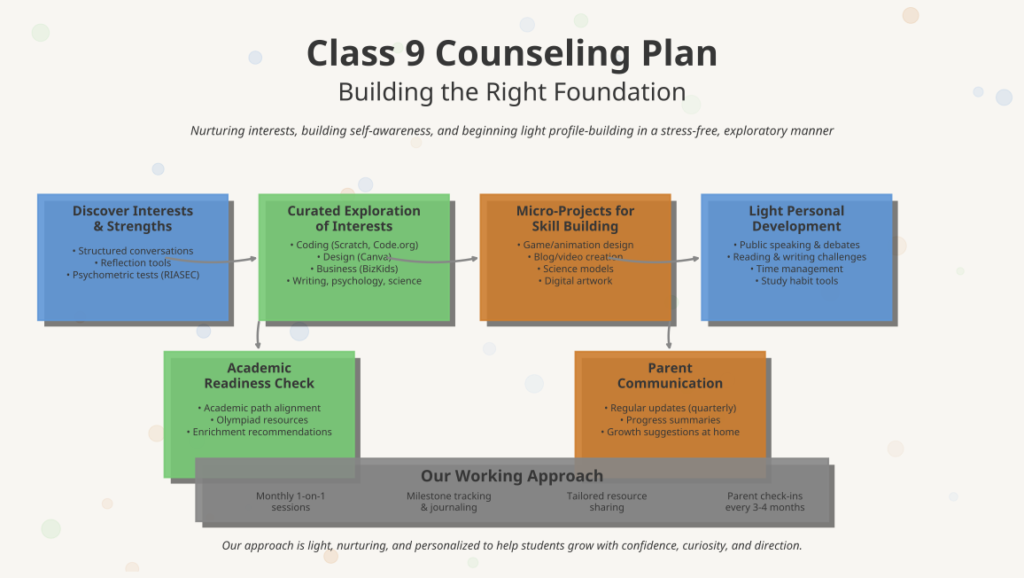
Grade 9:
- Diagnosis and baseline: understand interests, strengths, working style, and academic fit
- Development lanes: choose 2-3 serious areas instead of chasing random activities
- Output-based work: small projects, writing, reflection, or skill-building that show real thinking
- Opportunity filtering: competitions, courses, workshops, and summer ideas chosen for fit
- Review and next plan: adjust based on school load and what the student is actually responding to
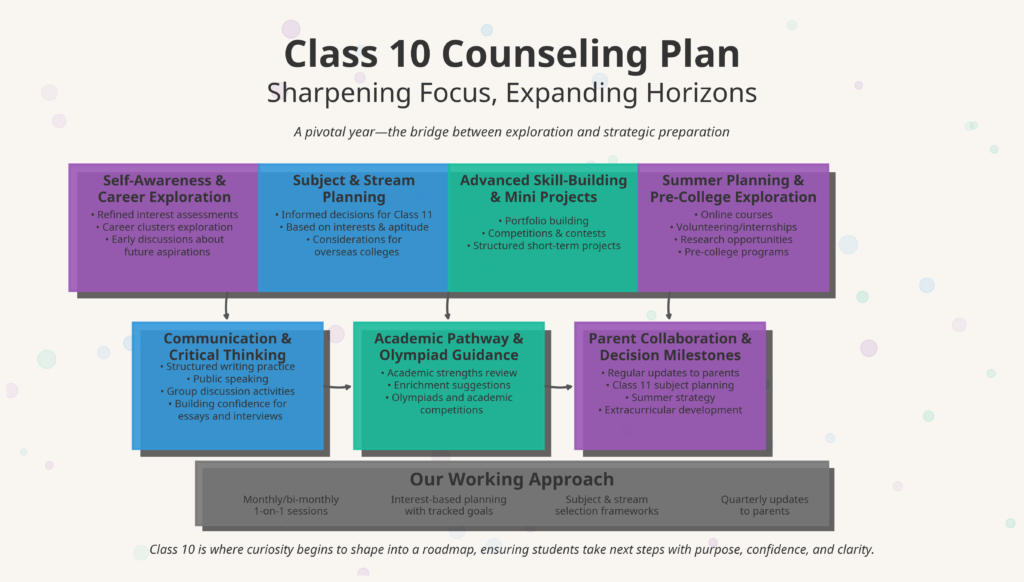
Grade 10:
- Academic and subject direction: use Grade 9 evidence to think more clearly about Grade 11 choices
- Deeper projects and competitions: strengthen the lanes that are beginning to look real
- SAT/AP planning where relevant: plan testing sensibly without letting it take over
- Summer planning: use the summer after Grade 10 for skill-building, testing, projects, or a useful programme
- Transition to Grade 11: begin country and application strategy only when there is enough evidence
Our approach at this stage is light and exploratory, but the operating rhythm is deliberate. The goal is to help the student grow into their potential with curiosity and direction, not to optimize their profile for a school they haven’t even heard of yet.
Why Start This Early?
Most families come to us in Grade 11. By then:
- Course selection is locked
- There’s no time to develop genuine depth in activities
- The student has to discover their interests AND write about them in the same year
- Summer opportunities have already been missed
Starting in Grade 9 or 10 gives us two years to explore without pressure. That exploration is what produces authentic applications later.
A Pattern We See
A student came to us in Grade 10 with a long list of activities: MUN, debate, coding club, volunteer work, music, sports. Eight things, none deeper than surface level.
We worked with her to identify which two actually mattered to her. She dropped six activities and went deep in two. By Grade 12, she had real stories to tell. Her essays wrote themselves because she’d spent two years doing something she genuinely cared about.
Admissions officers don’t count activities. They look for genuine investment.
What This Can Look Like In Practice
Every student is different, so we do not use fixed templates. But these are the kinds of patterns we often work with in Grades 9 and 10.
A student interested in economics, finance, and markets
Sometimes a student shows an early pull toward money, markets, business, or economics. At this age, we would not turn that into a fixed career label too quickly. We would test it.
- Keep a simple market or business observation journal
- Write short explainers on financial ideas they are curious about
- Build a basic spreadsheet model for tracking or comparison
- Identify relevant economics, finance, writing, or quiz competitions
- Decide which courses, workshops, or summer programs are actually useful
The aim is to move from interest to evidence: evidence that the student is thinking, building, and learning in a real direction.
A student leaning toward engineering or applied problem-solving
Another student may be broadly interested in engineering, coding, design, robotics, data, or applied science, but still unclear about what part of that world actually attracts them.
- Map whether the student is more drawn to coding, making, design, math, data, or systems
- Create a small prototype, project, write-up, or presentation
- Choose one or two competitions or enrichment programs that fit the student’s actual energy
- Help the student explain what they built, why they built it, and what they learned
- Use Class 10 to make better subject and stream choices for Class 11
For both kinds of students, the real counseling work is often filtering: helping families decide what is worth doing for this child, at this stage.
What happens after Grade 10?
By the end of Grade 10, the student should not have a finished college application plan. That would be too early. But they should have better evidence: subjects they are drawn to, activities worth continuing, skills that need work, and a clearer sense of what Class 11 should be used for.
Grade 11 is where that evidence becomes pre-application strategy. We look at academic depth, activity focus, testing plans, and early college direction before the application year starts to feel rushed.
Common Questions
Ready to talk?
No charge. We’ll talk about where your child is, what they’re interested in, and whether starting now makes sense for your family.
We don’t guarantee admissions. Nobody credible can. We focus on building strong applications and smart, realistic lists.