
Who This Is For
This is for you if:
- Your child is applying to the US or UK and the essays still feel vague, generic, or forced
- You want honest guidance on topic choice, structure, and revision, not a consultant or AI writing the essay
- The profile looks strong on paper, but the person is still not visible
- You want essays that fit the rest of the application instead of repeating the resume
This is not for you if:
- You want someone else to draft or heavily rewrite the essay in the student’s name
- You are looking for formulas, templates, or “topics that get kids in”
- You mainly want polish without reflection or ownership
Why essays and positioning matter
At selective colleges, a lot of applications start to blur together. Similar marks. Similar activities. Similar ambition. The question is not just whether the student can write. It is whether the application helps a reader understand who this student is and what to remember about them.
This is also where families get into trouble. The student tries to sound mature, profound, or unusually accomplished, and the draft loses the very thing that made it promising. What admissions readers usually respond to is something quieter: specificity, self-awareness, and a voice that feels owned.
Some of the best essays are not dramatic at all. They simply feel true to the student.
How we build positioning into the essays
1. Discovery before drafting
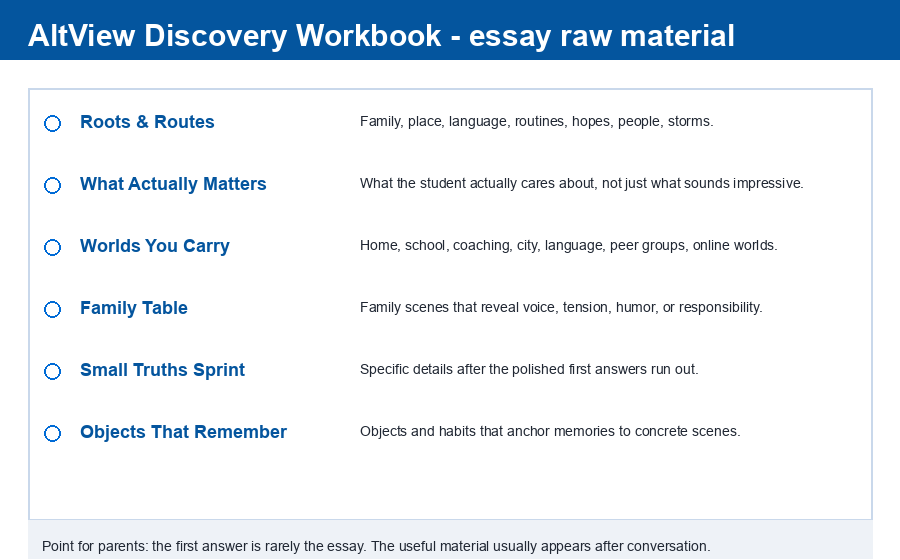
We do not begin by forcing a prompt. We begin by figuring out where the real material is: moments, tensions, habits, responsibilities, relationships, obsessions, contradictions.
Most students have more to work with than they think. We use structured exercises and conversation to surface things like:
- moments that changed how the student saw something
- patterns that repeat across school, family, work, and activities
- details that reveal character rather than just achievement
By the time drafting begins, we want more than a topic. We want usable material.

The prompt is not where the essay starts
When students first answer essay questions, they often give safe answers: achievement, leadership, service, ambition, resilience. All of that may be true, but it may not yet be specific enough.
What we do before drafting
- Build an inventory of moments, habits, tensions, questions, and small scenes.
- Separate material for the main essay, supplements, activities, and recommendations.
- Test which stories reveal character, not just accomplishment.
What we are looking for
- Specific lived material, not a polished summary of values.
- A voice that still sounds like a thoughtful 17-year-old.
- A story that strengthens the rest of the application instead of repeating it.

2. Choosing the right angle
Once the raw material is on the table, we decide what the essay should actually do. Sometimes the most impressive story is the wrong one. Sometimes a good draft overlaps too much with the rest of the application. We help students choose the angle, prompt, and structure that make the application stronger as a whole.
3. Drafting and revision
Students write their own drafts. Our job is to show them what is not yet landing:
- where the structure drifts or the essay loses shape
- where the reflection is still thin
- where the language stops sounding like the student
- where one concrete detail would do more than another polished sentence
We want the essay to stay readable and sharp without turning into something the student would never actually say.

4. Activities and recommendations
Common App activities section:
We help students tighten the activities list so it supports the same picture of the student instead of repeating or diluting it.
Recommendation letters:
We help students prepare brag sheets and context notes so teachers and counselors can reinforce the right qualities without sounding manufactured.
5. Interview preparation
When interviews matter, we prepare students to talk the same way we want them to write:
- explaining interests without sounding rehearsed
- answering open-ended questions with real examples
- staying calm when the conversation goes somewhere unexpected
The goal is not a slick interview. It is a grounded one.

Supplemental essays are a research project
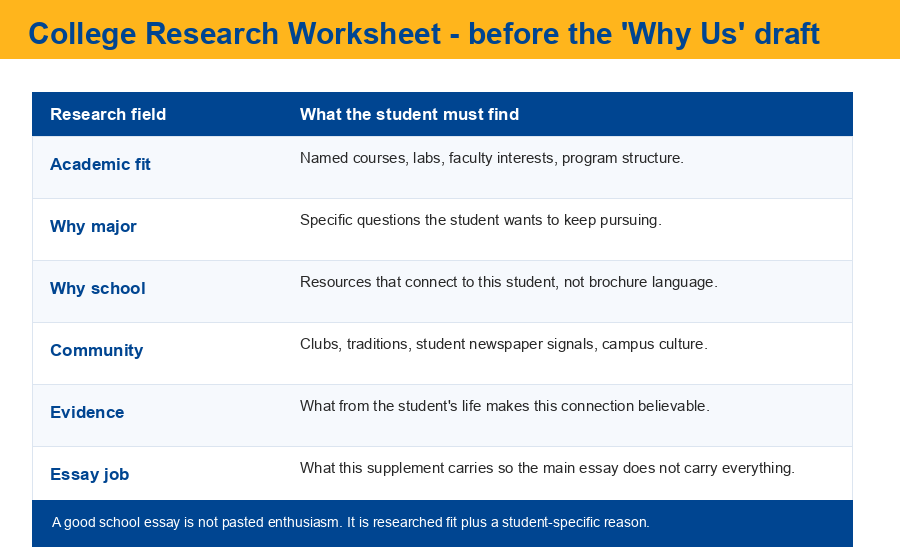
Why Us, Why Major, community, and contribution essays cannot be written from brochure language. They need real research and a believable student connection.
Why this college?
We look for named courses, programs, labs, communities, or opportunities, and then ask why they make sense for this specific student.
Why this major?
A strong answer shows real curiosity: questions, projects, reading, problems, classroom moments, or habits the student keeps returning to.
What will you contribute?
We connect the student’s past choices and communities to what they are likely to bring into the next campus, without making the answer sound inflated.
This is why August feels late. Research and fit cannot be faked at deadline speed.
What’s included in full essay coaching
What’s Included
- Personal statement: discovery, topic selection, outline, and revision rounds
- Supplemental essays: strategy and feedback for up to 10 colleges / 20 supplementals
- Essay map so different prompts do different work across the application
- Activities section review and language tightening
- Recommender guidance and brag sheet support
- Two mock interview sessions
- Two brainstorming sessions to surface stories and themes
- Two annotated feedback rounds for each essay
What We Need From The Student
- Time: This works best when we start early enough to think, not just edit under deadline pressure.
- Ownership: The student has to do the writing. We can guide the process, but we cannot substitute for the student’s thinking.
- Honesty: The useful material appears when the student stops performing and starts answering plainly.
What We Don’t Do
We don’t ghostwrite. The student writes every word that goes into the application.
We do not outsource authorship to AI either. AI can be useful for brainstorming, research, or counselor-side critique. It should not be writing the submitted essay in the student’s name.
We don’t use templates. No “winning essay” formulas. No recycled structures from previous students. Each essay starts from the student’s own experience.
We don’t over-polish. A 17-year-old’s essay should still sound like a 17-year-old. If the draft becomes too smooth, too adult, or too careful, something important has usually been lost.
Common Questions
Ready To Talk?
We’ll talk through where the process stands, what feels stuck, and whether this is the right kind of support for your family.
We don’t promise outcomes. We help students produce essays and applications that are honest, coherent, and much harder to forget.