Too many maths Olympiads. IOQM, AMC, BMO, CIMC… it becomes an alphabet soup quite quickly. A school circular mentions one, a coaching centre talks about three others, and soon a parent is wondering whether they all lead to the same place. They don’t. Even the word Olympiad doesn’t tell you what sort of paper your child will sit.
I would start by looking at a past paper, and at the organiser’s rules for what happens after that paper. This is more useful than starting with the name of a coaching programme. A child can be very good at school maths and still find a proof problem completely unfamiliar.
If you are in India, start with the Indian route
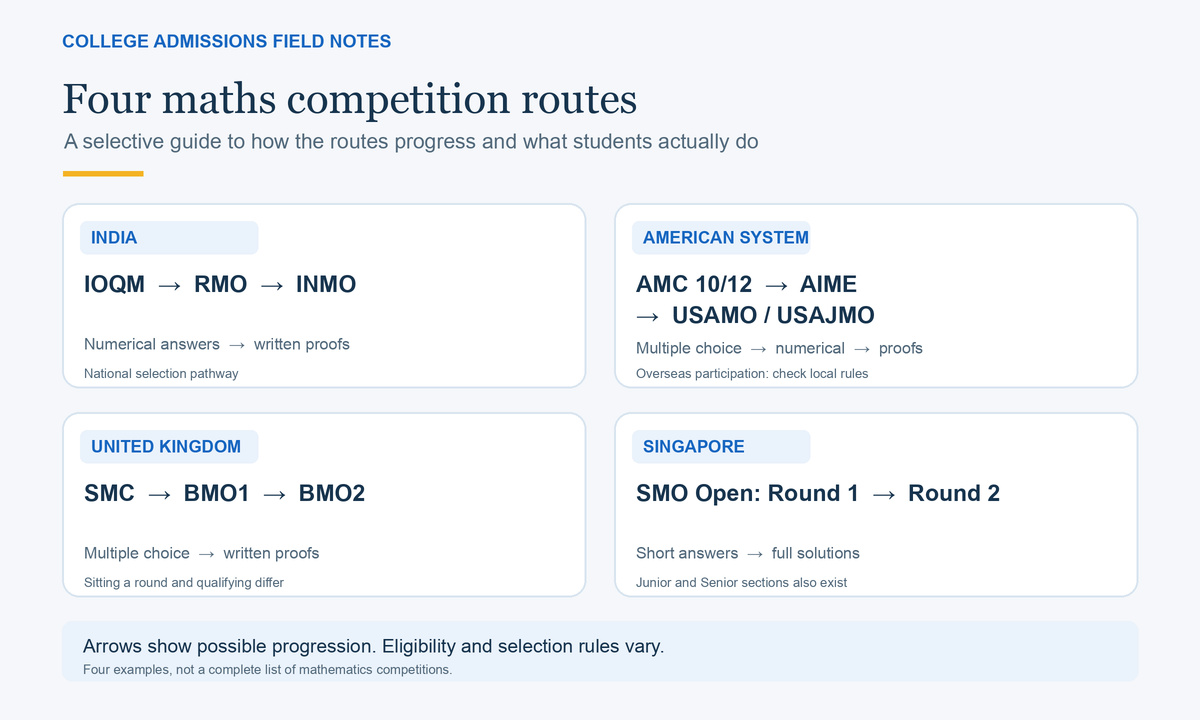
If by “Olympiad” you mean the competition that can eventually lead to a place on India’s team at the International Mathematical Olympiad, the starting point is the Indian Olympiad Qualifier in Mathematics (IOQM). Qualifying students move on to the Regional Mathematical Olympiad (RMO) and then the Indian National Mathematical Olympiad (INMO). There is further training and selection after that. You cannot simply register for whichever stage sounds right; the progression rules matter. HBCSE sets out the 2026–27 stages here.
RMO and INMO ask for written proofs. A student has to show why an answer is correct, clearly enough for someone else to follow. It is easy to think of this as just a harder version of school maths. The student is doing a different kind of work here, and it takes practice. I would want to see whether they enjoy it before signing them up for a long preparation schedule.
IOQM 2026 was held on 6 September. If you have only just discovered it, use some of the published papers to see whether your child wants to try next year. Wait for the next cycle’s announcement before planning registration. Official IOQM portal.
What about AMC, BMO and Singapore?
View the graphic at full size.
The American Mathematics Competitions begin, for the age group we are discussing, with AMC 10 or AMC 12. Students studying in India can take these through the international programme and, with a qualifying score and the required eligibility, continue to AIME, where answers are numerical. Confirm the arrangements with the Indian organiser. The MAA has also announced a change for AIME 2027: the exam will have two 90-minute parts. MAA’s current guidance.
If your child is in an IB school in India, please check this distinction carefully. Studying IB does not give them access to the full American ladder from India. Under the 2027 rules, USAMO and USAJMO require students to have taken AIME in the US or Canada, be enrolled full-time in a school there, and physically attend school there during the specified period. Travelling there just to sit the exam would not meet those schooling requirements. So for a student continuing at school in India, the available American sequence is generally AMC → AIME, whether they study IB, CBSE or another curriculum. Official USAMO/USAJMO rules, pages 4–5.
IB students can also enter India’s IOQM route if they meet its other eligibility requirements; the official FAQ explicitly includes IB. A family can explore both sets of problems without assuming that both lead to a national-team place.
In the UK system, the Senior Mathematical Challenge can lead to the British Mathematical Olympiad rounds, which ask for written arguments. Here is a detail that often gets lost: a student can sometimes enter BMO1 or BMO2 through a registered centre without having earned the usual qualifying score. Sitting the paper, qualifying by performance, and eligibility for a UK team are different things. So if someone says a student “did BMO2,” I would ask how they got there and what the result was. UKMT; British eligibility policy.
Singapore’s Singapore Mathematical Olympiad has Junior, Senior and Open sections. In the Open section, the first round has short questions; selected students go on to a second round with full solutions. It is another useful paper to look at, provided you check the section and entry rules for your child rather than going by the name alone. Singapore Mathematical Society; Open-section rules.
And the ones a school offers?
There are plenty of competitions outside those four routes. The University of Waterloo’s Canadian Intermediate Mathematics Contest, or CIMC, is a two-hour paper for Grades 9 and 10 that includes written solutions. HUSO India is broader: its first round covers maths alongside biology, chemistry, physics and earth science. Neither feeds into India’s IMO team selection.
Then there is SOF’s International Mathematics Olympiad. Its abbreviation, IMO, is the same as that of the International Mathematical Olympiad for national teams. They are separate competitions; an SOF result is not a stage in India’s team-selection route.
Would I rule out a school-organised competition because of that? No. If the school makes it easy to register and sit the paper, it can be a perfectly sensible first attempt. Just look at the paper beforehand, and be precise afterwards. “Olympiad winner” could mean several very different things. Name the organiser, the round and the actual result.
Before you sign up for coaching
Give your child one IOQM question with a numerical answer and, on another day, an RMO problem asking for a proof. They may solve the first and have no idea how to write up the second. That does not settle whether they are good at maths; many schools give students little practice in writing proofs. Try a few problems without a timer and see whether they want to understand the solutions and have another go.
I would also be careful with the admissions pitch. People will tell you that American universities prefer American competitions, or that a certain certificate is necessary for a maths or computer science application. I do not think the competition rules can tell us that. They tell us how a student qualifies and what an award means within that competition. If a student has achieved something substantial, describe it accurately. An ordinary first attempt can still be worthwhile if it gets a younger student more interested in the subject.
Finally, ask what preparation will do to the student’s week. A course may promise IOQM, AMC and BMO together. How many classes and practice hours does that mean, on top of school? Trying papers from several systems is easy enough. Preparing seriously for all of them is another matter. I would usually choose one main route and add another only when the student has a reason to pursue it and time to do the work.
If you are unsure where to begin, take a few official past problems to a maths teacher and ask which ones are at the right level. Let your child try them before buying a year’s preparation. You will have a much better conversation after that.