


I did well in school and went on to IIT and IIM. I make no apologies for taking academics seriously. So I get a little impatient when I hear that grades are less important in the US because colleges are looking for “holistic profiles”. The way some people explain it, you’d think a student could spend less time on maths because they’ve got a couple of MUNs coming up.
Take two students applying to MIT, Stanford or Princeton. One is excellent at debate and Model United Nations, but their school results are consistently middling in the subjects they want to study. The other has done very well in demanding courses and is a perfectly ordinary debater. Which of the two would stand a better chance of acceptance? I’m pretty sure it will be the second.
At these colleges, I’d treat academic strength as table stakes. If there’s a serious gap in your child’s preparation, I would spend the next term fixing it before signing them up for anything else.
That’s my judgement about those two examples. So I did some data analysis against published data – mainly each college’s Common Data Set (CDS) and what their admissions officer says.
Know a parent who’d find this useful?Send this article to another parent. Article link (right-click or press and hold to copy). |
What the colleges say about academics
Stanford calls academic excellence its primary criterion and looks first at the transcript, taking into account the courses the student could take. Here’s a quote from their admissions page:
Academic excellence is the foundation of your application. Your preparation through challenging coursework and your potential to succeed are key factors in our contextual review.
Yale puts academic strength first too and calls the high school transcript the most important document in the application. To quote again:
Yale’s first and most important consideration is academic potential. What Brewster called “a sharp and inquiring mind coupled with a capacity and desire to use it constructively and effectively” may also be understood as a strong scholastic foundation; a capacity for critical thinking; intellectual initiative; and an ability to benefit from Yale’s expansive academic resources.
Princeton asks students to take demanding courses where they’re available and gives some idea of what that means. If you’re applying for engineering, it recommends calculus as well as physics and chemistry. It also puts four years of English, with continued writing practice, on its suggested course list. That’s worth remembering if your child is interested in history or literature and the conversation about academic preparation at home tends to begin and end with maths.
How I’d read the Common Data Set
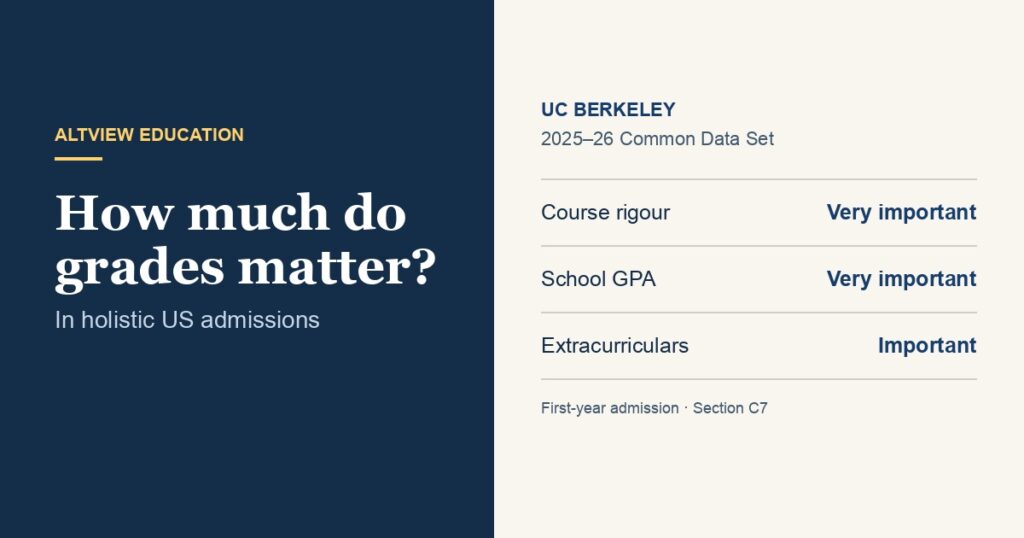
I wrote earlier about how to read a Common Data Set. Here’s one example. UC Berkeley calls both course rigour and school GPA “Very Important”. It rates extracurricular activities “Important”.
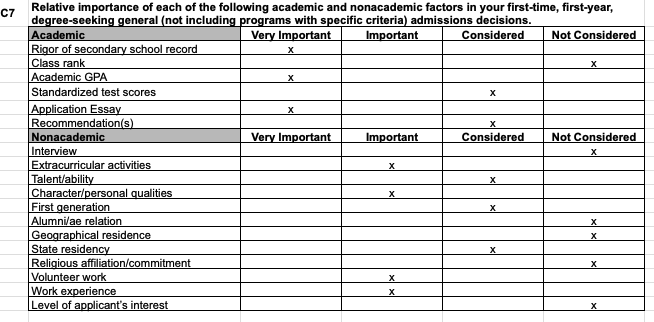

Source: UC Berkeley’s 2025–26 Common Data Set, Section C7. Berkeley’s admissions office says it doesn’t use SAT or ACT scores in admissions. The broader “standardized test scores” row is easy to misread.
Now look at Stanford. Its Common Data Set calls grades, course rigour and extracurriculars “Very Important”. The same university tells applicants, in the words quoted above, that academic excellence is the foundation. I’d read those two things together. The tick marks tell you which things the college takes seriously. They don’t tell you whether strong activities will carry an application if the student is struggling in school. Stanford’s Common Data Set
MIT says it looks for outstanding academics and a strong match with the Institute. Princeton says it looks for academic excellence and strong extracurricular accomplishments. And Yale tells you outright what it considers first. That’s how I’d read the ratings as a parent. I’d start by asking whether your child’s school record gives an admissions reader confidence they can do the work. Their activities can give the reader another reason to want them on campus. MIT · Princeton · Yale
Share with your WhatsApp groupsCopy the message below, or tap the button to choose a chat or group.
|
What a strong SAT score tells you
MIT’s admissions office says its own research found that the SAT and ACT help it judge whether students are academically prepared. Look at the first-year students who enrolled in autumn 2025. Among MIT’s SAT submitters, the middle 50% scored 1520–1570 overall and 780–800 in Maths (83% of the class submitted the SAT). Stanford also reported 1520–1570 overall (56% submitted). At Yale it was 1480–1560 (67%), and at Princeton 1490–1560 (60%). MIT on academic preparation and testing
The ranges vary even among places people tend to group together for engineering. At Caltech it was 790–800 in Maths (78% submitted). Georgia Tech reported 1370–1530 overall (78%), and Illinois reported 1390–1520 (43%). Those are university-wide ranges. If your child is applying to a particular engineering or CS programme, look for figures for that programme as well.
I find the SAT useful as a rough gauge of some academic skills. A strong Maths score tells me something about a student’s quantitative preparation. For a student who wants to read history, I’d also want to see the work they turn in when they have a week to read sources and make an argument. And when you look up a score range, remember whose scores it describes. These students had already got in, chosen to enrol and submitted the SAT. MIT’s 780 is the 25th percentile for that group. I use the range as one reference point when building a college list.
Get our free summer programmes guideWe’re finishing a guide to summer programmes, competitions and research. It includes a shortlist of opportunities and the questions to ask before paying for a programme or project. Leave your first name and email. We’ll send you the guide when it’s ready. |
Start with what your child is studying now
When I say academics, I start with what your child is studying at school, how demanding it is given the choices available, and how they’ve done over time. If your school offers IB Higher Level maths and your child wants to study engineering, that choice deserves attention well before you start picking summer programmes. If there’s a poor term, look at what happened and how they did afterwards. That’s a different conversation from finding that they’ve struggled with maths for two years and are now applying for engineering. Princeton’s recommended course of study
AP exams and Olympiads can add evidence of what your child can do. A strong AP Calculus result can show that they’ve mastered material beyond what their school offers. Progressing through a serious maths Olympiad can show what they can do with unfamiliar problems. A test score has to be read against the college’s actual policy. MIT requires an SAT or ACT. Berkeley uses neither for admission. I’d make time for the test if it’s relevant to the list, and for an AP or an Olympiad if there’s a good reason to do it. If schoolwork is already slipping, I’d put the extra prep on hold and work out what’s going wrong. Caltech on STEM preparation · AltView’s maths Olympiad guide · MIT testing · Berkeley testing
Academics are also easier to measure. A transcript shows what your child studied and how they did over several years. Marks need to be read in the context of the school, and a common exam can give you another point of comparison. With activities, you can count awards or hours, but those numbers only take you so far. A debate trophy tells you how a student did at one event. To understand what debate has meant in their life, I’d want to know how they got better at it and what they did for the team. There’s no common scale on which to compare that with the work of a student who spent two years on the school newspaper.
Once your child is doing well in demanding school courses, I’d take their activities seriously. A student who spends years getting good at debate and helps younger students find their feet gives a college something it can’t learn from their marks. There’s also a perfectly good reason to keep debating if they just love doing it. But if your child is behind in physics and the next MUN would take up the weekend they need to catch up, I’d skip that MUN. Let them get back on top of physics, then see what there’s room for next term.
Want the next Field Note in your inbox?Subscribe for free to College Admissions Field Notes. |