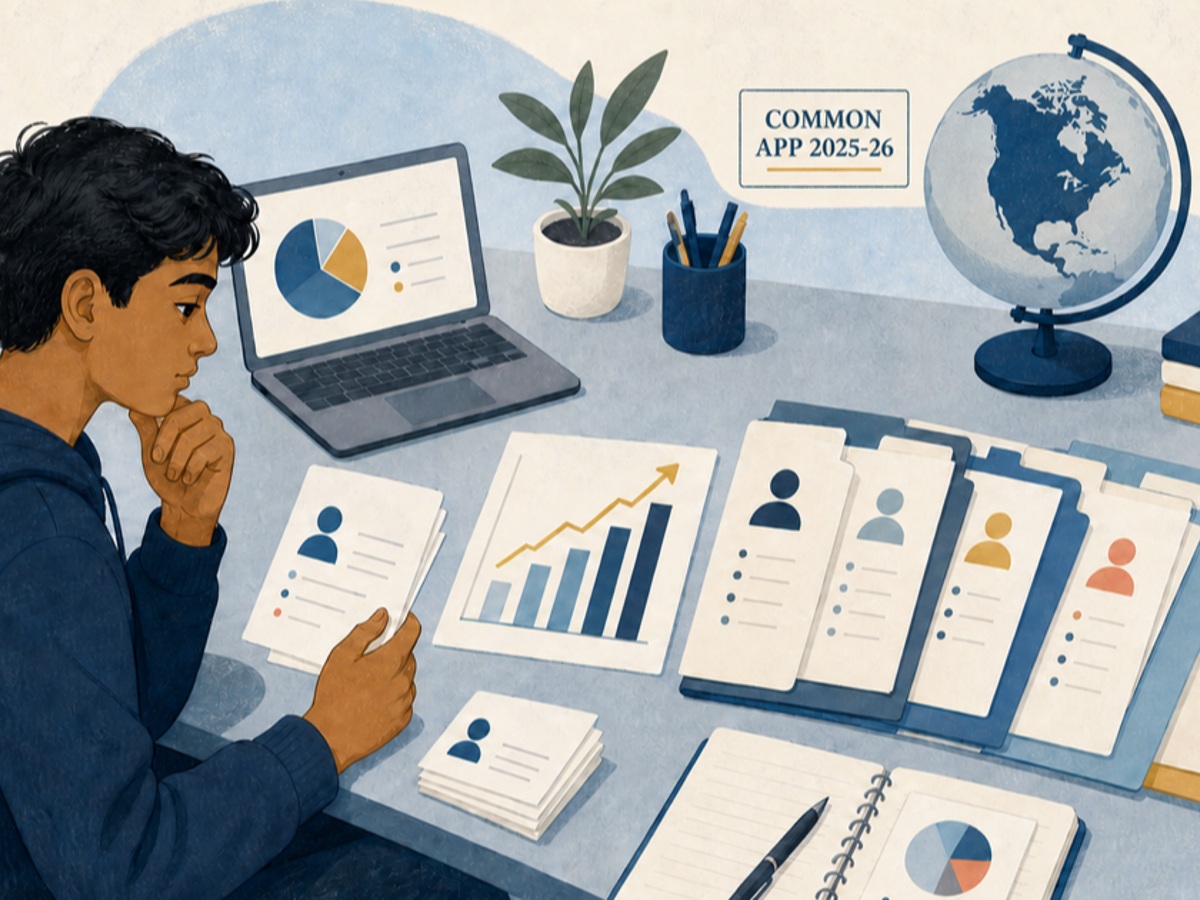
Common App published its final report on the 2025-26 application season on 20 August. It covers 1.53 million first-year applicants and 10.79 million applications submitted to 1,146 member institutions.
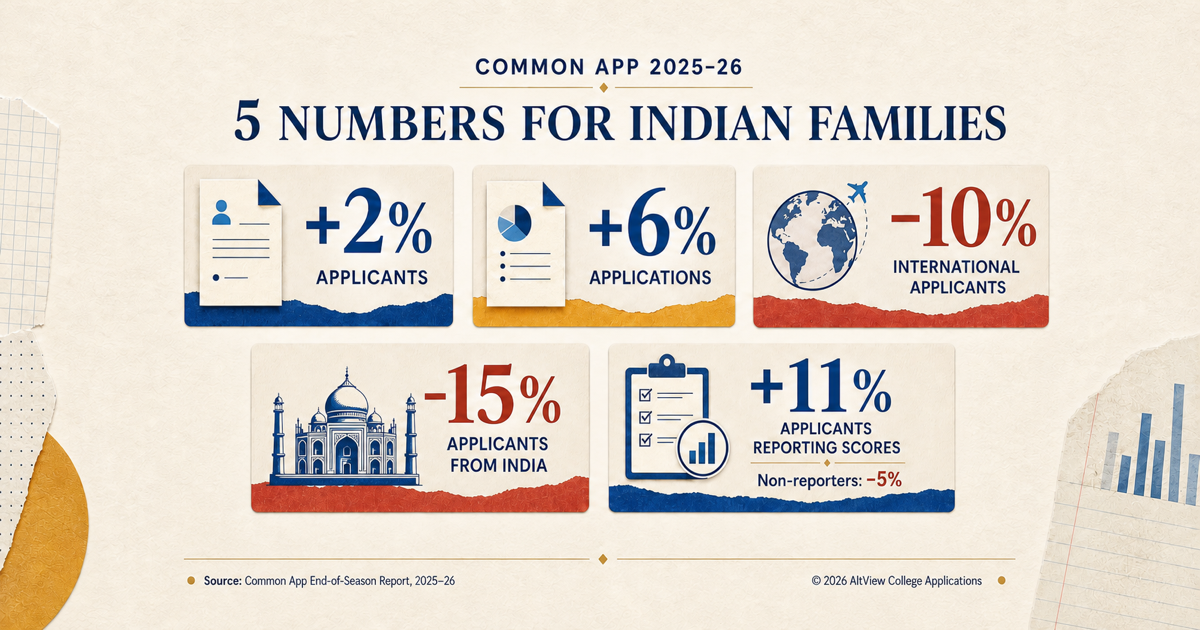
For an Indian student planning Fall 2027 applications, five figures caught my attention:
- The number of applicants rose 2%.
- The number of applications rose 6%.
- International applicants fell 10%.
- Applicants from India fell 15%.
- Applicants reporting a test score rose 11%, while the number applying without one fell 5%.
A parent looking at the 10% decline could reasonably ask whether US admission has become easier. The report does not support that conclusion. I would be cautious about changing a college list on that assumption. It counts students across the Common App platform, but does not show how many international places a particular college offered, how many of its applicants needed financial aid, or how its own pool changed.
I find the report useful for understanding changes in application behaviour, testing and workload. Moving a university from reach to target still requires evidence from that college.
What the 10% figure tells us
Asia, the largest international region on Common App, was down 11%. India fell from roughly 17,000 applicants to 14,424, a 15% decline. China, still the largest country represented, fell 2%.
At the same time, total applications across Common App rose 6%. Applications to the most selective group, colleges admitting fewer than 25% of applicants, rose 3%. The other three selectivity bands grew between 5% and 8%.
These figures can coexist because an applicant and an application are different units. One student may submit several applications. The average Common App applicant sent 7.06 applications, up from 6.79 a year earlier. Common App also added more member institutions during the year.
The report says international application volume was weaker across every selectivity band. It does not publish international admit rates for those bands. A smaller international pool may still face difficult odds when the number of places is small, especially at colleges that consider a family’s ability to pay.
For students seeking substantial aid, the national decline is particularly hard to translate into an admission estimate. Common App does not report how many international applicants requested aid or how much money individual colleges set aside for them. The family’s budget and each university’s current international-aid policy still have to shape the list.
Could US policy be part of the decline?
Some parents will read the decline as evidence that visa uncertainty and US government policy are discouraging international applicants. That is possible. Common App did not ask students why they applied or stayed away, so its report cannot tell us how much of the decline came from policy, visa appointments, cost, safety concerns or interest in another destination.
NAFSA’s Fall 2026 outlook identifies falling applications, visa-appointment bottlenecks and restrictive immigration changes among the challenges facing international enrolment. Its figures are a forecast rather than a final Fall 2026 count, and NAFSA explains the limits of the underlying survey data.
The IIE Fall 2025 snapshot complicates the story. International undergraduate enrolment was up 2%, even as new international enrolment across all academic levels fell 17%. It also found that 84% of responding institutions considered international recruitment a priority. Universities can continue recruiting international students while federal rules make arrival and longer-term planning harder.
I would not drop the US merely because the policy environment feels unsettled. If the student’s strongest academic and financial options are there, the US plan deserves to remain. A parallel route in another country can reduce dependence on one admissions and visa system, provided the student has researched those universities and would genuinely attend. A few hurried applications to unfamiliar institutions provide less protection than families imagine.
Students should also check I-20 timing and international-office support at the colleges on their list. We have discussed the new fixed-period F-1 rule and its implications in a separate article.
More applications came from a slowly growing pool
The 2% growth in applicants and 6% growth in applications can look contradictory at first. The gap comes partly from students submitting more applications.
The platform itself became larger. Active membership increased 4%, from 1,097 institutions to 1,146. Applications to public members rose 7%, compared with 5% at private institutions, while the number of public members grew 10%.
For a family building a list, the extra applications create extra work even when the form is already open. A new university brings essays and deadlines, followed by another affordability calculation. Before adding it, the student should know what role it serves and whether they would choose it over the other available options.
What happened at individual selective colleges?
The Common App report does not name individual institutions in its selectivity charts. I checked current disclosures from several highly selective colleges to see whether they filled the gap. Most do not yet provide a comparable international-applicant count for the Fall 2026 cycle. The latest Common Data Sets generally describe students who entered in Fall 2025.
Dartmouth is one of the few colleges to have released some current-cycle detail. It received 28,863 applications for the Class of 2030, up 2.2%, and later said international applicants represented about one-third of the pool. Its earlier Common Data Set used a different reporting context, so I would not calculate an international growth rate by comparing the two. Dartmouth’s current pool remained large and heavily international while the Common App aggregate fell.
I would leave a selective college in its existing category unless its own evidence supports a change. That review includes the college’s available data and financial-aid policy, read alongside the student’s record. Even after that work, the most selective colleges remain uncertain for almost everyone.
More applicants are reporting test scores
Only 5% of Common App members required a test score in 2025-26. Even so, 779,300 applicants reported one, an 11% increase from the previous year. The number who did not report a score fell 5%. Score reporters outnumbered non-reporters for the first time since 2019-20.
The rise in score reporting does not change a college’s published policy. Test-optional still leaves the submission decision with the student, and the figures are a good reason to make that decision deliberately. For an Indian student, an early SAT or ACT attempt preserves choices. A useful score may support applications in the US and at some universities elsewhere. A student can decide against submitting after checking the result, the college’s current policy and the rest of the academic record.
What I would do with a Fall 2027 list
I would keep reach, target and likely categories unchanged unless college-specific evidence supports a revision. Then I would remove colleges the student would not attend and check whether the testing plan still preserves enough options. If policy or affordability risk is worrying the family, this is also the time to build a genuine route outside the US rather than adding unfamiliar universities later.
The 10% decline helps us understand the season that has just ended. To estimate one student’s chances at one university, families still need to return to the college, the student’s record and the family budget.