For students targeting an early admission round, the application deadline no longer feels far away. This is crunch time.
Many students open the Common App, enter some biographical information and perhaps paste in an activities list, and get a sense that the application is under way. The assumption is that the student will finish the form, upload the essay and press submit. Recommendations, school documents and the college-specific work will somehow fall into place around it.
The problem usually becomes visible only when the family opens one college properly. There is another writing supplement. The school’s internal deadline for submitting the brag sheet is earlier than the college deadline. A teacher has agreed to recommend the student but has not received the formal request. The college wants a financial-aid form or a portfolio through another system. Suddenly, “the Common App is mostly filled” does not tell us very much.
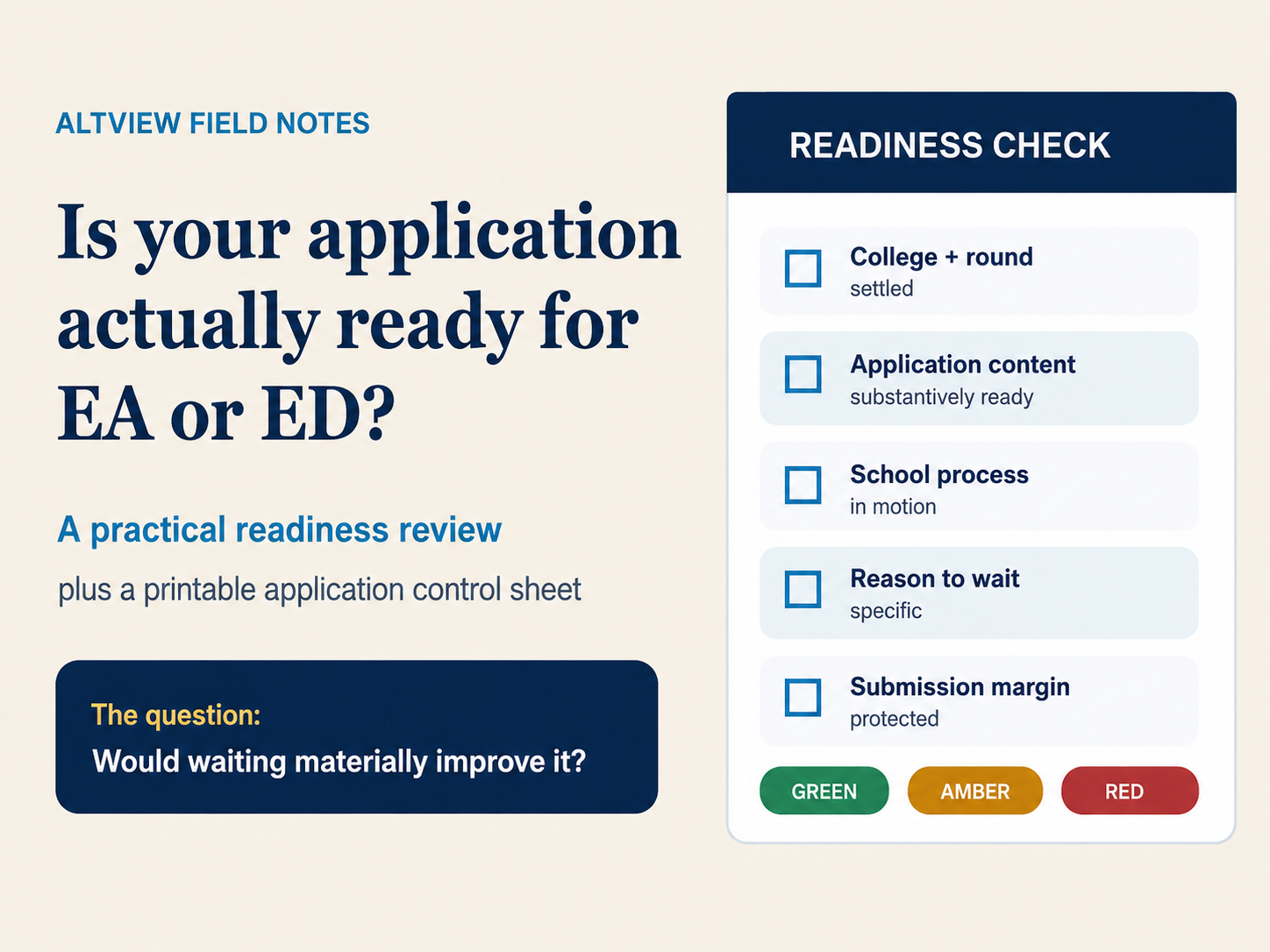
So when a parent asks me whether the application is ready for EA or ED, I do not begin with the percentage completed on the dashboard. I begin with one college and ask: Is this the application the student is ready to be judged on, or would waiting until Regular Decision materially improve it?
First, EA and ED are different decisions
EA is generally non-binding, although Restrictive Early Action and Single-Choice Early Action can limit where else a student applies early. ED is a binding commitment, so it needs another conversation away from the essays. Imagine that the acceptance arrives in December. Is the student ready to withdraw every other application? Has the family looked carefully enough at the likely cost to make that commitment? “We will work it out if the offer comes” is a sign that the ED decision itself is unfinished. A high early admit rate does not resolve this. Early pools can include recruited athletes and applicants whose circumstances are quite different, and the headline number says little about places or aid available to an international applicant like your child.
Read the application as an admissions reader will
Open the application preview for that one college and read it from beginning to end. I find it easier to do this on paper. Read the Common App essay, then the activities, additional information and college supplements without editing as you go. The experience is quite different from opening each box separately over several weeks.
You may discover that the student has repeated the same achievement three times while leaving an important part of school life unexplained. The intended major may appear for the first time in a supplement and have no connection to anything else in the application. A “Why Us?” response may be grammatically finished but still usable for five other universities after changing the name. None of these problems is visible in a green Common App tick.
I am not suggesting that the application must tell one beautifully coordinated story. Real students have interests that do not line up neatly, and an admissions reader knows that. But the reader should be able to understand what the student has done, why certain choices matter, and anything about an Indian school or curriculum that would otherwise be easy to misread. If several supplements are still missing, or the Common App essay is moving between unrelated subjects, the work is not yet at the proofreading stage. Completing the remaining form fields will not take it there.
If you wait, what becomes better by January?
This is an important question to ask of the student. “More time” does not count. A later test score that the college will consider is a reason. So is a meaningful academic update, a substantial piece of work close to completion, or essays that still need thought rather than cosmetic editing. The family should be able to name the expected improvement and explain why it will matter to the person reading the application.
If no one can do that, waiting may simply move the same application into January. On the other hand, families sometimes persist with an early plan because they have discussed it for months and now feel committed to it. If the college choice is unsettled, important essays are generic or missing, or the school process has barely begun, the application has material gaps. I would set an internal decision date, decide what must be true by then, and move the college to RD if it is not. That is much better than renegotiating the decision every evening until the deadline.
I also would not use a generic calendar to make this call. Students are starting from very different places. One may have a strong Common App essay and two unfinished supplements; another may have finished the writing but not spoken to the school counselor. What helps is a control sheet that shows the unfinished work, its owner, the real deadline and the next action. That is why we made the printable below. Use one sheet for each college and round, since the requirements and the decision may differ.
The Green, Amber and Red labels are meant to support a decision. Green means the college and round make sense, the writing is ready for a full read, and the school process is moving. Amber means there is one material gap with a named owner and a credible plan; if it is still open on the family’s decision date, the application moves to RD. Red means the ED commitment or affordability is unresolved, several written components remain weak, or the school process has hardly started. The answer can differ by college. A student can be ready for one EA application and not another.
There is some less glamorous checking to do alongside this review. Confirm the school’s internal forms and deadline. Make sure the counselor and teacher requests have gone through the system the school uses, and that each recommender has the correct college date. Then check testing policies, portfolios, scholarship applications and financial-aid requirements on the college’s own site. Some of these sit outside Common App entirely.
The final box on the control sheet asks the family to record the reason to wait, if there is one. Once the answer is written down, it becomes much easier to decide whether the application should go early and what still has to happen before it does.
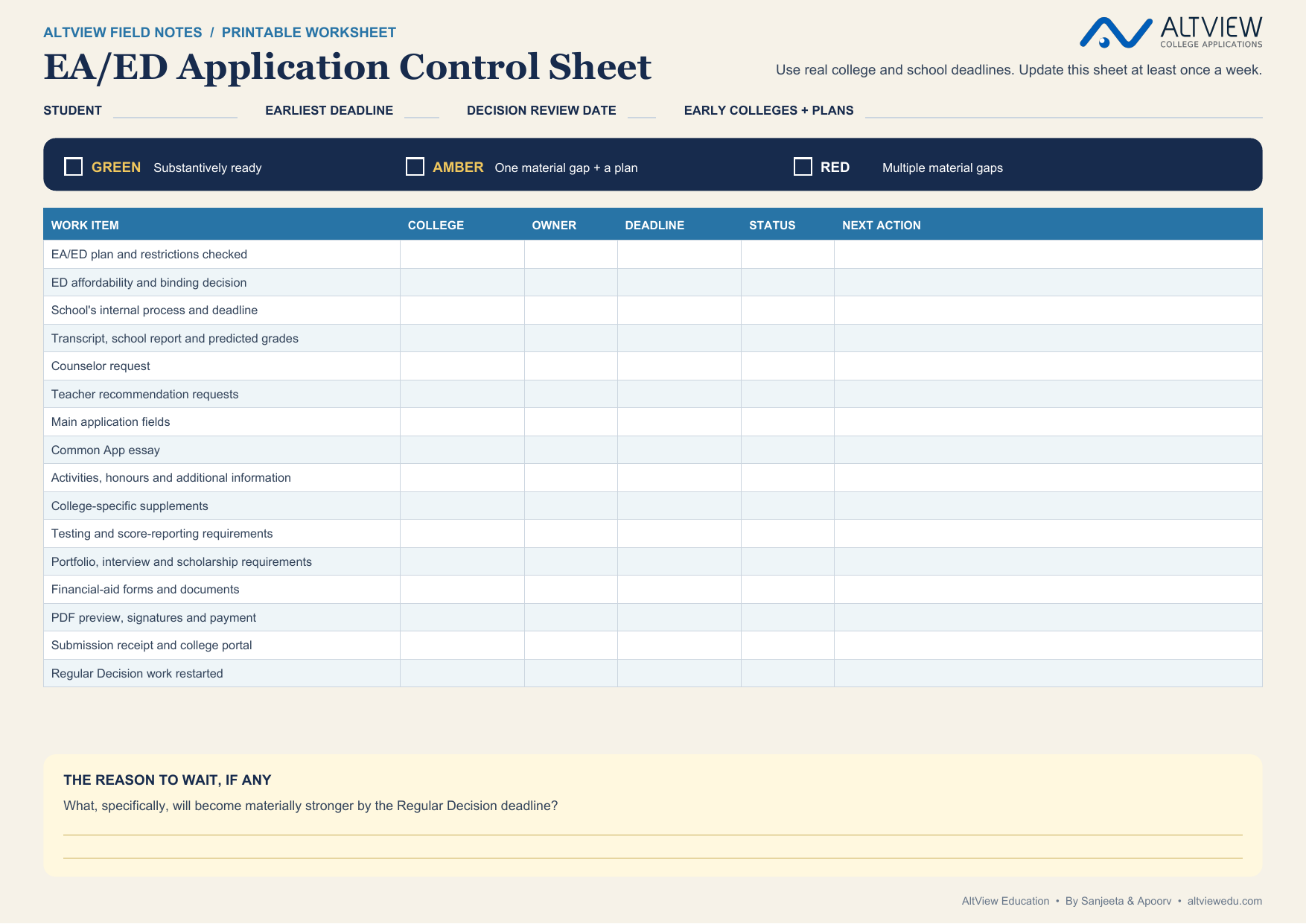
Want a clean PDF copy? Email [email protected] and we will send you the printable EA/ED Application Control Sheet.
Once an early application has been submitted, activate the college portal and check what has actually been received. Then return to the Regular Decision work. A family that waits for the early result before beginning its January applications can find itself back in the same situation in December: a deadline is approaching, but there is still no plan.