


I have been thinking about a February 2026 paper called The Digital Divide in Generative AI: Evidence from Large Language Model Use in College Admissions Essays by Jinsook Lee, Conrad Borchers, AJ Alvero, Thorsten Joachims, and Rene F. Kizilcec. The authors looked at 81,663 applications submitted to one highly selective U.S. university between 2020 and 2024. That is a big sample, and it is worth taking seriously.
It is also one institution, not the entire admissions world, and the study is observational. So I would not turn it into a sweeping claim that AI use causes rejection or that every smooth essay is suspect. Still, the paper points to something families should pay attention to: AI can improve the surface of an essay while quietly reducing what makes the student recognizable.
What the study actually looked at
The researchers were not watching students write in real time. They studied the essays that were ultimately submitted and estimated where AI use may have been more likely. That makes the paper useful for spotting broad patterns, not for declaring who did or did not use ChatGPT.
Essay conversations online get sloppy very quickly. People want a clean story: AI is ruining essays, or AI is leveling the playing field, or admissions offices can now spot everything. This paper is more restrained than that. It offers signals from a large dataset, but not a courtroom verdict on individual applicants.
The part families should care about
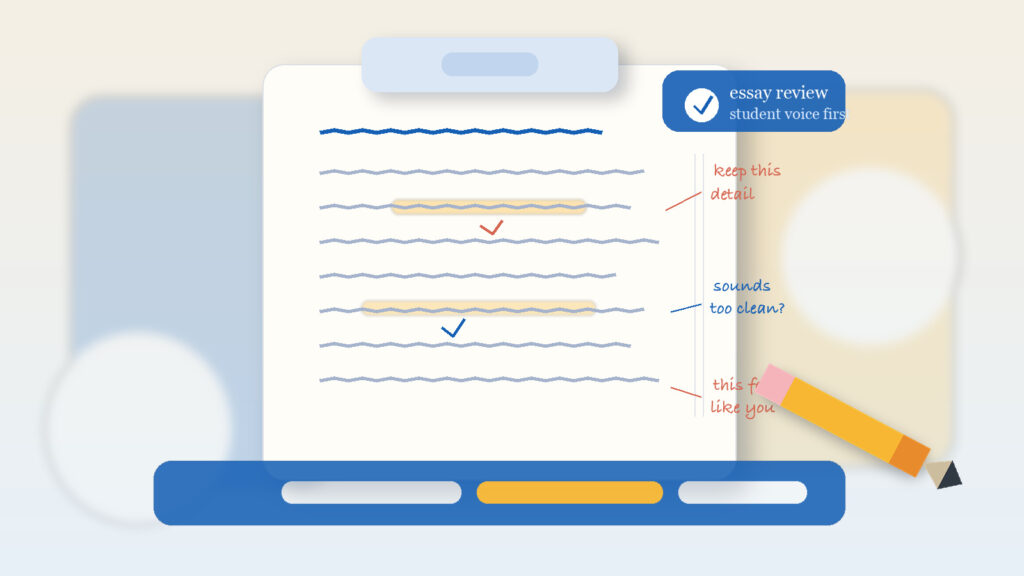
The most interesting finding, to me, is not simply that estimated AI use went up after 2023. It is that essays also appear to have become more similar on the surface. The paper suggests a flattening effect: writing gets cleaner, while differences become less visible in some of the features the researchers measured.
That tracks with what many counselors have already started to feel anecdotally. A lot of drafts are easier to read now. Fewer are memorable.
The paper also finds that estimated AI use rose more among lower-income applicants. That does not mean something improper is happening. In many cases it probably reflects access. If a family does not have a counselor, an older sibling who has been through U.S. admissions, or a parent who knows how these essays work, AI becomes the cheapest and fastest form of help available.
What the paper does not prove
This is the part I would want students and parents to hear clearly. The study does not prove that AI use leads to worse admissions outcomes. It does not show that admissions officers can reliably identify AI-written essays one by one. And it does not say that any student who used AI support somehow cheated the process.
The authors are careful about this, and they should be. The period they study overlaps with other large shifts, including the aftermath of the pandemic and the 2023 Students for Fair Admissions v. Harvard decision. In other words, the essay landscape was moving for several reasons at once. The paper shows a pattern. It does not settle causality.
What this means for students applying in 2026
If you are applying in 2026, the practical question is not “Should I touch AI at all?” That is no longer a very useful question. The better question is whether the tool is helping you think more clearly or whether it is slowly replacing your own judgment.
AI is genuinely useful for some parts of essay work. It can help a student get unstuck. It can also tell them when a draft is repeating itself or when they are too close to the page to see what it is actually saying. It can even be helpful as a blunt second reader: this paragraph is confusing, this opening takes too long, this conclusion sounds generic.
Where students get into trouble is when the tool starts generating the actual insight or the language that carries the essay. At that point the draft may become more polished, but it often becomes less revealing. And in admissions, revealing beats polished.
What parents and counselors should watch for
I would be careful about equating “cleaner” with “better.” Parents often read a smoother draft and feel relieved. Counselors can fall into the same trap if they focus too quickly on grammar and flow.
I would ask a different question instead: does the essay still sound like one specific teenager? Does it contain observations that feel lived, not merely well phrased? Is there a sentence that only this student would have written? Did revision sharpen the student’s thinking, or did it sand off the edges until the draft could belong to almost anyone with strong grades and decent activities?
That is why I still care so much about the rough early work. Topic choice matters. The first honest draft matters. The student’s own language matters. If those pieces are missing, AI can improve the packaging while weakening the application.
How I would use AI without letting it take over
My advice is fairly simple. Use AI after the student has real material on the page, not before. Use it to pressure-test a draft or point out where the writing is vague. Do not use it to invent the core story, rewrite the whole piece into adult English, or manufacture reflection that the student has not actually done.
One practical check helps here. After a round of AI-assisted editing, ask the student to read the essay aloud. If the language feels borrowed or oddly unlike them, that is useful information. Something important may have been edited out.
This paper does not tell families to panic about AI. I do not think that is the right lesson anyway. But it does highlight a real risk. You can improve the sentence-level writing and still make the essay less useful to an admissions reader. In our view, the essay is there to help a reader meet a real person, not reward the cleanest prose in the pile. That old-fashioned job still matters.
Need help with essay strategy?
At AltView, we are not anti-AI. We are also not interested in letting a tool flatten a student’s voice into something admissions readers have seen a hundred times before. If your family wants essay support that protects authenticity while still using AI sensibly, book a 30-minute discovery call.