A parent asked me recently whether the UK application is simpler than the US application. My honest answer is: only after the groundwork is clear.
From the outside, I understand the attraction. The UK process looks cleaner. Fewer university choices. Fewer essays. No long activities list. No Common App-style attempt to explain the whole student through school, family, personality, hardship, ambition, and extracurricular life.
For some students, that narrower focus is a relief. The UK application cares much more about the course: what the student wants to study, whether they are prepared for it, and whether their academic record supports the choice. But for an Indian Class 12 family, the pressure can arrive earlier than expected. By July, course choice, subject evidence, predicted grades, reference inputs, test calendars, and school deadlines may already be connected.
The course comes first
In the US, a student can often keep some academic breadth alive for longer. Many colleges allow students to apply undecided. Even when a student names a major, the application can still show a wider pattern: classes, essays, family context, projects, activities, and the way the student thinks.
The UK gives much less room for that kind of broadness. The course choice sits at the centre of the application. Economics is a different academic field from management. Computer science requires different preparation from psychology. Engineering and data science raise their own questions about maths, technical work, and evidence.
So when a Class 12 student is still saying, “Maybe economics, maybe business, maybe psychology, maybe data science,” I would slow the family down. At that stage, picking universities first usually creates a false sense of progress. Each of those routes requires different proof, and a list built before the course direction is clear can quickly become messy.
Before shortlisting, I would want the family to answer a simpler, harder question: what course can this student make a credible academic case for?
The new personal statement is more structured
The personal statement format has changed. For 2026 entry onward, UCAS has moved away from one open-ended personal statement and toward three structured questions. In plain terms, students will have to explain why they want the course, how their formal studies have prepared them, and what they have done outside formal education to prepare.
Students who dislike a blank page may prefer the new format because the prompts are clearer. The same structure also makes weak preparation harder to hide.
If a student can only explain the subject in terms of career outcomes, the new format will expose that. If their school subjects do not connect cleanly to the course, the gap will show. If the outside-classroom evidence is a pile of unrelated activities, the structure may make the application feel thinner rather than stronger.
Families sometimes treat the personal statement as a writing problem. Writing matters, of course, but the bigger issue is preparation. What has the student read, built, solved, questioned, written, or tried outside the minimum school requirement? Which part of their academic work points toward this course? Why should a reader believe they understand the subject well enough to study it seriously? If those answers are thin in July, nicer sentences will only do so much.
Five choices still require judgment
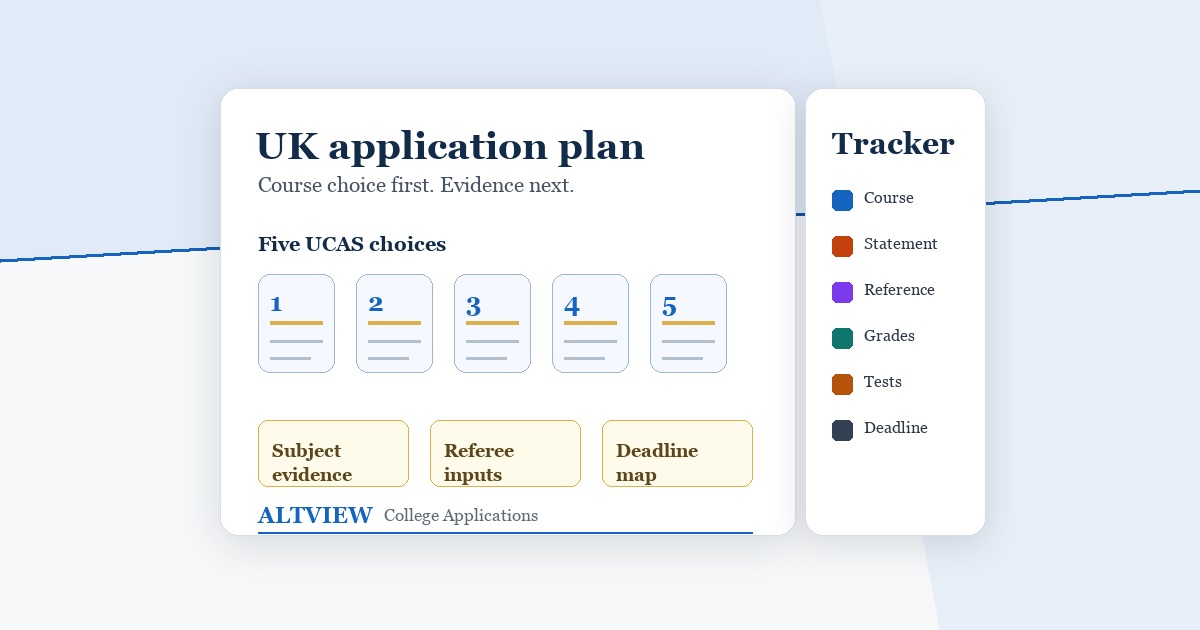
UCAS allows a student to apply to up to five choices. Five sounds manageable, especially when families compare it with US lists of 12 or 15 colleges. The smaller number creates a different kind of pressure: there is less room for casual additions.
Each choice must make sense for the course, the student’s academic level, the likely offer terms, the family’s risk tolerance, and the student’s willingness to attend. A familiar university name is a poor shortcut here. Two universities may both offer economics, but their course structures, maths expectations, assessment styles, flexibility, placement options, and selectivity can be quite different. Engineering or computer science courses can vary even more.
For a UK shortlist, I would build a course-level tracker. For each choice, the family should know the exact course being selected, why it fits the student, what requirements or preferences exist, whether there is a test or interview, what predicted grades are likely needed, and how realistic the choice is.
The tracker can feel like paperwork at first. Later, it is often what saves a family from discovering too late that one attractive university was never a sensible choice for that course.
The reference needs inputs
Families also underestimate the school reference. For UK applications, the reference should not be treated as a generic praise letter collected near the end. UCAS adviser guidance treats references and predicted grades as part of the application process handled through the school or centre. If the student has pending qualifications, predicted grades are also included in the submission.
For Indian students, this needs planning. Many students have useful academic evidence sitting outside the ordinary classroom: a technical project, independent reading, a research exposure, an online course, a competition, an internship, or a serious school project. The school referee may not automatically know the depth of that work.
The family should not write the reference. But the school often needs factual, relevant inputs so the reference supports the same academic case as the personal statement and course choices.
If the student is applying for engineering, “hardworking” is too vague on its own. It helps if the referee understands what technical problems the student attempted, what kind of maths or physics work they handled well, and where the student showed readiness for a demanding course. If the student is applying for economics, a general line about being sincere and disciplined will not carry much weight unless it connects to the student’s academic direction.
A useful reference does not need inflation. It needs specificity.
Predicted grades can shape the list
Predicted grades can also create late stress. For many international applicants, offers are conditional. Universities review what the student has already done and what the school expects the student to achieve in pending qualifications.
Families sometimes treat predicted grades as a school-side formality. In practice, they can affect list realism. If the predicted grades are unclear, the shortlist remains partly unresolved.
For selective courses, the course requirements, school predictions, and the student’s actual academic evidence need to line up. Otherwise, the list may look impressive on paper while carrying more risk than the family realizes.
Tests and interviews need a calendar
Some UK courses and universities add another layer: admissions tests, interviews, written work, portfolios, or other course-specific requirements.
I would not work from hearsay here. The exact requirements depend on the course and university, so I would check the course pages and create a calendar. This is especially important for students who are also applying to the US or preparing for Indian exams.
A test that looks manageable in isolation may become difficult when it lands on top of school exams, board work, essay drafting, project deadlines, and reference coordination. The student may be capable of preparing, but the calendar still has to carry out the preparation.
UK planning can become surprisingly heavy for exactly this reason. A family may choose the UK because it looks cleaner, then discover that course choice, tests, reference inputs, predicted grades, and personal statement evidence all need attention at the same time.
The UK can still be the right path
None of this is an argument against the UK. For the right student, it can be a very strong path.
A student with a clear academic direction may appreciate the course focus. A student who already knows what they want to study may prefer a system that gets to the subject quickly. Some families may also like the shorter undergraduate duration, the clearer course structure, or the way the application concentrates attention.
I would simply be careful with the phrase “easier than the US.” The UK asks for a convincing academic case, built through the five choices, the personal statement, subject evidence, the reference, predicted grades, test or interview planning, where needed, and the deadlines around all of it.
If those pieces are handled late, the application may still get submitted. It may also be weaker than it needed to be.
What I would do in July
For a Class 12 family keeping the UK on the table, July is a good time to pressure-test the plan before school pressure takes over.
I would ask:
- What course is the student actually applying for?
- Is that choice based on real academic interest, or mostly on how the career sounds?
- Which five UCAS choices are plausible, and why?
- What evidence will go into the personal statement under the new structure?
- What will the school referee need to know?
- Are predicted grades likely to support the current ambition level?
- Are there tests, interviews, portfolios, written work, or early deadlines?
- If the student is also applying to the US, are we building two coherent applications or trying to reuse one story everywhere?
These questions are much easier to handle before the calendar becomes crowded. By September or October, families are often trying to make course decisions, chase documents, prepare for tests, draft essays, and manage school exams at the same time. Even a focused UK application starts feeling messy then.
At AltView, this is the kind of planning we try to do before the season becomes noisy: course direction, shortlist realism, personal statement strategy, reference inputs, predicted-grade risk, testing calendar, and how the UK plan fits with the US or other options.
The UK application can be focused, efficient, and a very good fit. It still needs work. For families applying this cycle, July is a sensible time to begin that work properly.
If your family is deciding between the UK, the US, or a mixed strategy, you can book a discovery call with us.