Most parents I talk to have never heard of the Common Data Set. That’s not surprising — most counselors don’t mention it either. But here’s the thing: it’s one of the most useful tools you have when planning your child’s college applications, and it’s completely free and publicly available.
Let me tell you what it is and why it matters.
What Is the Common Data Set?
The Common Data Set (CDS) is a standardized survey that US colleges fill out every year. It contains detailed information about the school — admissions statistics, financial aid data, student demographics, and most importantly for us, what factors they consider in admissions decisions.
Every college that participates publishes their CDS as a PDF on their website. You can find it by Googling “[College Name] Common Data Set” — usually the first result takes you right to it.
Inside this document is Section C7, which lists every admissions factor and rates its importance: Very Important, Important, Considered, or Not Considered.
This is not marketing copy. It is a useful starting point for understanding how a college describes its admissions process in its own words.
What the Data Actually Shows
Let me show you what four top schools — MIT, Stanford, Princeton, and Harvard — reported in their most recent CDS.
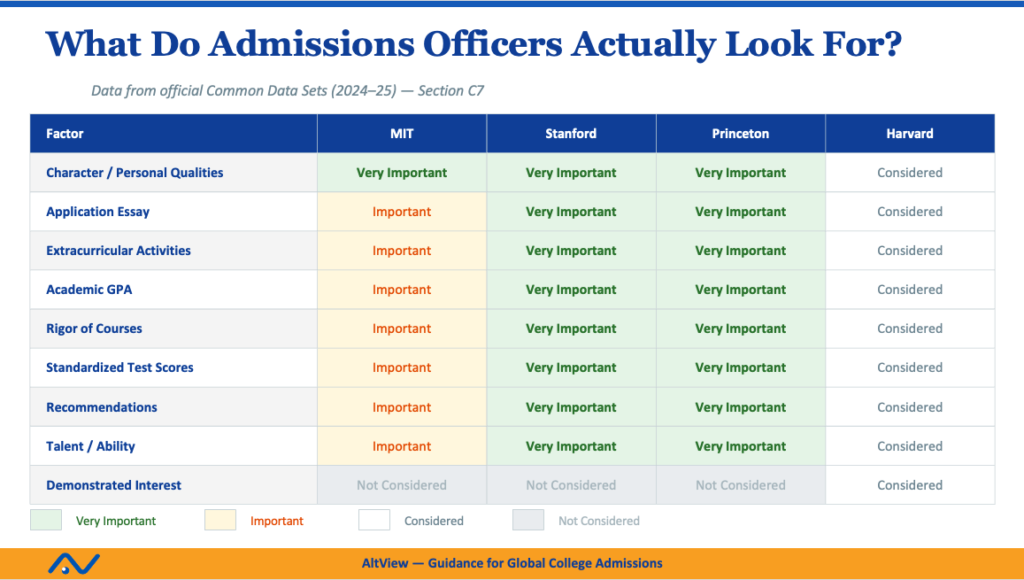
MIT’s column is striking. Character and Personal Qualities stands out prominently in the CDS table. That does not mean grades, scores, essays, and activities do not matter. It means MIT is signaling that academic readiness alone is not enough.
Think about what that suggests. Even at a place like MIT, numbers alone are not the story.
Stanford and Princeton look broadly demanding across both academics and non-academic factors. The takeaway is not that every line item carries identical weight in every case, but that these schools are evaluating for strength across the board.
Harvard is less revealing in the CDS than the other schools here. The table is still useful, but it should not be read too literally.
And look at the bottom row: Demonstrated Interest. All four schools say it’s “Not Considered.” Visiting campus, attending webinars, signing up for their mailing list — none of that helps your admissions chances at these schools.
Parents spend thousands of rupees on US campus tours thinking it’ll improve their odds. The colleges are telling you it won’t.
What This Means for Your Strategy
Here’s where most families go wrong. They assume all top colleges want the same thing, so they build a generic “strong application” and send it everywhere.
But the CDS suggests that these schools are not identical. MIT appears to place unusual emphasis on character and personal qualities, Stanford’s profile is broad across categories, and Harvard’s table gives you less interpretive clarity.
If your child is applying to MIT, the essay and recommendations — where character shows up — become critical. You’re not just listing accomplishments. You’re showing who your child is when no one is watching.
If your child is applying to Stanford, you need strength across the board. A 1570 SAT with weak extracurriculars won’t cut it. Neither will amazing activities with a 3.7 GPA. They want both.
And Harvard? Don’t read “Considered” as meaning academics matter less. At this level, academics are obviously central. The point is that the CDS needs interpretation, not blind reading.
The MIT Insight: Character Over Credentials
Let’s zoom in on MIT, because this is where the CDS reveals something most parents miss.
MIT is an ultra-selective school, and the academic bar is extremely high. At that level, numbers alone stop being a useful way to distinguish between strong applicants.
So what does?
MIT’s published materials consistently point back to character and personal qualities as a meaningful part of evaluation once academic readiness is established.
What does that mean practically? It means MIT is asking: Who are you when no one is watching? What do you care about, and can you articulate why? Do you have a spike — deep, authentic passion in one or two areas — or are you a generic high-achiever who checks every box?
The essay and recommendations are where character shows up. That’s why we spend so much time with students on story discovery and reflection. Not because we’re trying to manufacture a personality, but because most 17-year-olds haven’t been asked to think deeply about what drives them.
MIT’s admissions office says it best: “We admit people, not numbers.”
What the CDS Doesn’t Tell You
Of course, the CDS has limits. Here are a few things it won’t tell you:
Institutional priorities. At highly selective schools, special categories such as legacy applicants, recruited athletes, and development cases can materially affect how competitive the remaining pool is. The CDS won’t spell that out for you.
The narrative. When 50,000 applicants have similar stats, what sets your child apart is a coherent story. Who they are, what drives them, why this specific school. That’s what admissions officers remember when they’re in committee, deciding between 20 equally qualified candidates. The CDS can’t measure narrative.
Holistic nuance. Harvard says everything is “Considered,” but we know academics matter enormously. The CDS gives you the framework, but you still need to interpret it in context.
How to Use the CDS
Here’s what I recommend:
1. Look up the CDS for every school on your list. Not just the top schools. Mid-tier schools, safety schools, all of them. Section C7 is your starting point.
2. Compare across schools. Does School A rate “Level of Applicant’s Interest” as Very Important while School B says Not Considered? That tells you where demonstrated interest matters and where it doesn’t.
3. Build your application strategy around it. If a school rates extracurriculars as Very Important, your activities list and essay need to showcase depth. If they rate character as Very Important, your recommenders need to speak to who you are, not just what you’ve achieved.
4. Check other sections too. Section B has admissions statistics (acceptance rates, SAT ranges, GPA distributions). Section H has financial aid data (percentage of students receiving aid, average package amounts). This is all useful when building your college list.
Why Most Counselors Don’t Use It
I’ll be honest with you. Most counseling agencies in India don’t reference the CDS. They rely on general advice, rankings, and anecdotal experience. That’s fine for some students, but it’s not evidence-based.
We build every student’s strategy on data like this, combined with the student’s actual profile and goals. Not guesswork alone, and not generic advice.
If you take one thing away from this post, let it be this: the Common Data Set exists, it’s free, and it’s one of the best public starting points for understanding how colleges describe their admissions process. Use it.
About AltView: We’re a student-first college counseling practice helping students get into top universities. We work with a small number of families each year, providing personalized, evidence-based guidance. If you’d like to talk about your child’s college plans, book a free discovery call.