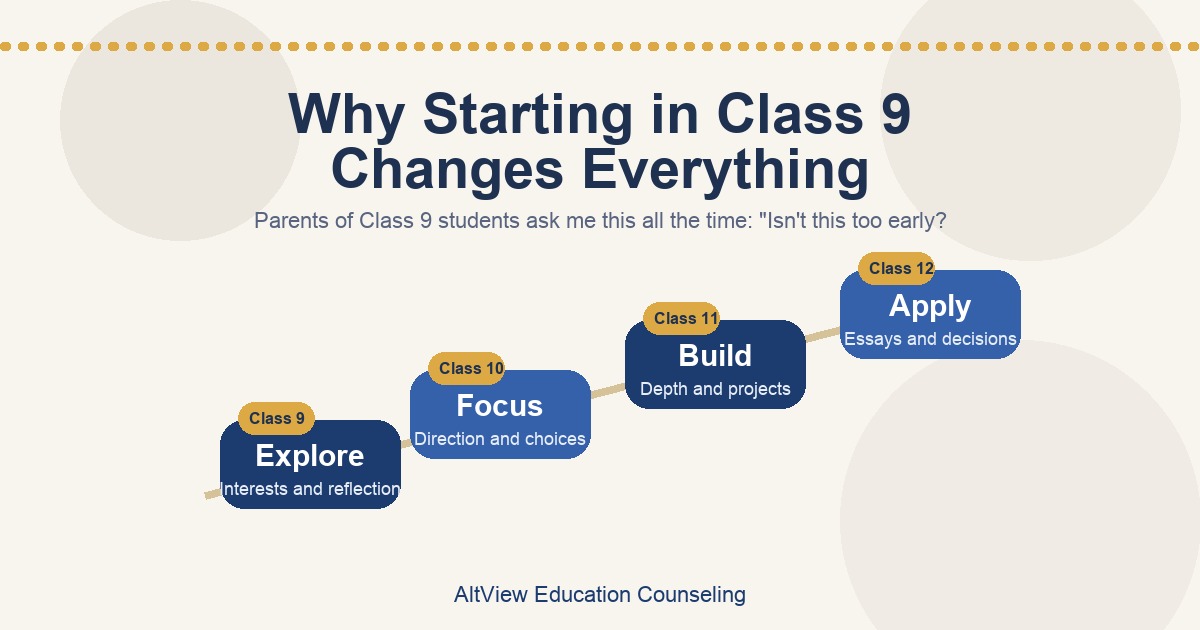
Parents of Class 9 students ask me this all the time: “Isn’t this too early? My child is only 14.”
My answer is usually no. But I also understand why they ask.
When people hear “start early,” they imagine something grim: a 14-year-old building a fake resume, collecting certificates, and treating every hobby like a future application bullet point. I would be against that too.
That is not the kind of early I mean.
The right kind of early is quieter. It is less about college and more about self-knowledge. It is a student getting enough time to figure out what they genuinely enjoy, what they are actually good at, and what kind of work energizes them instead of draining them.
That matters because strong applications rarely get built in Class 12. They get revealed in Class 12. The real building usually happened much earlier.
What early really means
Starting in Class 9 does not mean deciding between Stanford and Oxford at 14. It does not mean locking in a major before your child has even picked a stream. And it definitely does not mean manufacturing “passion projects” for admissions officers.
It means giving your child time.
Time to explore.
Time to be confused.
Time to try things and drop them.
Time to notice patterns.
Time to build something real, slowly, without the panic that comes later.
That is the real advantage.
Class 9 and 10: exploration first
For most students, this is the phase families rush past. They assume nothing “important” is happening yet. But this is often the phase that determines whether later work feels natural or forced.
In Class 9, the big question is not “Which college should my child target?” It is much simpler: what does this child actually care about?
That sounds obvious, but it usually is not.
A lot of students are bright and hardworking, but if you ask them what genuinely holds their attention, they do not know yet. They have spent years doing what school demands. Very few have been asked to notice what they return to on their own.
So this stage is about noticing.
Maybe the student likes coding, but only when they are building things, not when they are grinding syntax exercises.
Maybe they say they like science, but what they really like is explaining concepts, reading about ideas, and arguing about them.
Maybe they think they are “not creative,” but they will spend hours designing slides, editing videos, or writing stories.
Those distinctions matter.
This is where tools like reflection prompts, interest assessments, reading lists, low-stakes projects, and real conversations are useful. Not because they produce an immediate outcome, but because they help a student pay attention to themselves.
By Class 10, some of that fog starts to lift. Interests become a little less random. Patterns emerge. A student begins to move from broad exploration to sharper choices.
This is usually the right time to start thinking more intentionally about summers, courses, reading, competitions, projects, or volunteering. Not because “summer should look impressive,” but because the student is finally in a better position to choose meaningfully.
That is a much healthier starting point than the Class 11 scramble, where everything is suddenly urgent and every choice feels strategic.
Class 11: this is when strategy starts to matter
By Class 11, the work changes.
Now we are not just exploring. We are building.
If a student has spent the last two years figuring out what genuinely interests them, Class 11 becomes much easier to handle well. Their choices have a logic to them. Their projects build on something real. Their reading, essays, and college list begin to connect.
If they have not had that earlier runway, Class 11 gets messy very quickly.
This is when families start feeling the pressure all at once:
- stream selection
- grades
- standardized tests
- extracurricular depth
- college research
- essays not far away
That is a lot, even for a mature student.
If the student is also trying to discover who they are for the first time in Class 11, the whole process becomes heavy. They are not just building. They are inventing under deadline.
And that is usually when applications begin to feel artificial.
Class 12: execution, not identity formation
Ideally, Class 12 should be about finishing well.
Not panic. Not sudden reinvention. Not desperate profile-building.
By this stage, your child should already know the broad shape of who they are academically and personally. The essays should be hard, yes, but not because they have nothing real to say. The activity list should need shaping, not invention. The college list should need refinement, not guesswork.
When families start too late, three problems show up again and again.
First, everything feels rushed. There is no room to experiment, fail, regroup, and try again.
Second, the profile looks manufactured. Admissions officers are not naive. They can usually tell the difference between something built over time and something assembled in a hurry.
Third, the student is far more stressed than they needed to be. A lot of what families experience as “admissions stress” is really delayed planning stress.
The biggest misunderstanding about starting early
The biggest misunderstanding is that early planning means more pressure.
Done badly, yes. Absolutely.
There is a terrible version of this where adults hand a 14-year-old a target college list and tell them to start optimizing their life. That does burn students out. It also produces brittle, performative profiles.
Done properly, early work should feel lighter, not heavier.
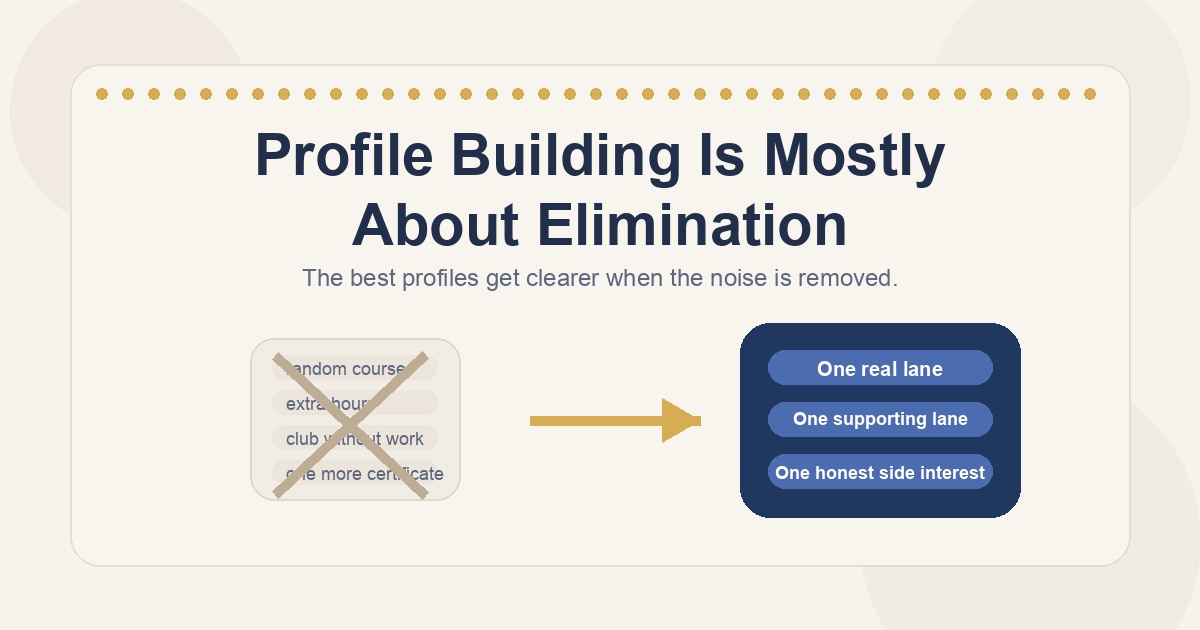
In Class 9 and 10, I would much rather see one thoughtful conversation a month than an overloaded schedule full of things the student does not care about.
I would rather see a child try three things and abandon two than stick with a fake interest because somebody said it “looks good.”
I would rather see curiosity than polish.
That is the point. The goal at this stage is not to create a college applicant. It is to help a student become more self-aware.
Counter-intuitively, that usually leads to stronger applications later.
Why time to fail matters
One underrated advantage of starting early is that it gives students time to fail without consequence.
That matters a lot.
If a student tries robotics in Class 9 and hates it, good. That is useful information.
If they start coding and realize they enjoy product design more than programming, also good.
If they think they want medicine, then discover they are far more interested in economics or psychology, even better to learn that in Class 9 or 10 than in the middle of Class 12 applications.
Students who start earlier usually look more coherent later, not because they got it right immediately, but because they had enough time to be wrong first.
That is how real direction develops.
What about IIT versus US or UK admissions?
Another thing families worry about is whether they need to decide the entire path now.
Usually, no.
In Class 9 and 10, many of the underlying habits are valuable across systems: strong academics, clear thinking, communication, discipline, intellectual curiosity, and some evidence that the student has interests beyond just test prep.
The actual fork in the road usually becomes sharper later, around Class 11, when stream choices, testing plans, and country-specific strategies start to matter more.
So early planning is not about locking in one destination. It is about building a student who has better options later.
What this can look like in practice
For students in Class 9 and 10, a sensible structure is usually pretty light.
Maybe one individual session a month.
Maybe some reflection prompts between meetings.
Maybe an assessment tool.
Maybe a conversation about reading, summer plans, or a small project.
Then separate strategy check-ins with parents every few months, especially around school choices, stream selection, summer use, and how much pressure is too much.
That is enough.
The work at this stage should create clarity, not noise.
And it is also completely fine if this process does not immediately produce something “impressive.” A student may spend months reading, thinking, trying things, and dropping them. That is not wasted time. That is often the foundation.
In fact, the students who later sound most convincing in essays are often the ones who had time to think before they had to perform.
So when should families start?
If your child is in Class 11 already, the answer is still: start now. Late is better than never.
But if your child is in Class 9 or 10, this is usually the sweet spot.
Not because it is time to build a resume.
Because it is time to help them understand themselves before the higher-stakes decisions arrive.
That is what changes everything.
Students who start earlier usually look calmer, clearer, and more natural later. Their applications make more sense because their choices make more sense. Their essays are easier to write because they are drawing from something real. Their profile has depth because it had time to develop.
That is the whole game.
About AltView: We work with students from Class 9 onwards, starting with discovery and self-awareness, then building toward strategic applications in Class 11 and 12. Our approach is purposeful but never pushy. We’re here to help your child figure out who they are and what they actually care about. If you’d like to understand how early counseling could help your child, book a free discovery call and we’ll talk through your situation.