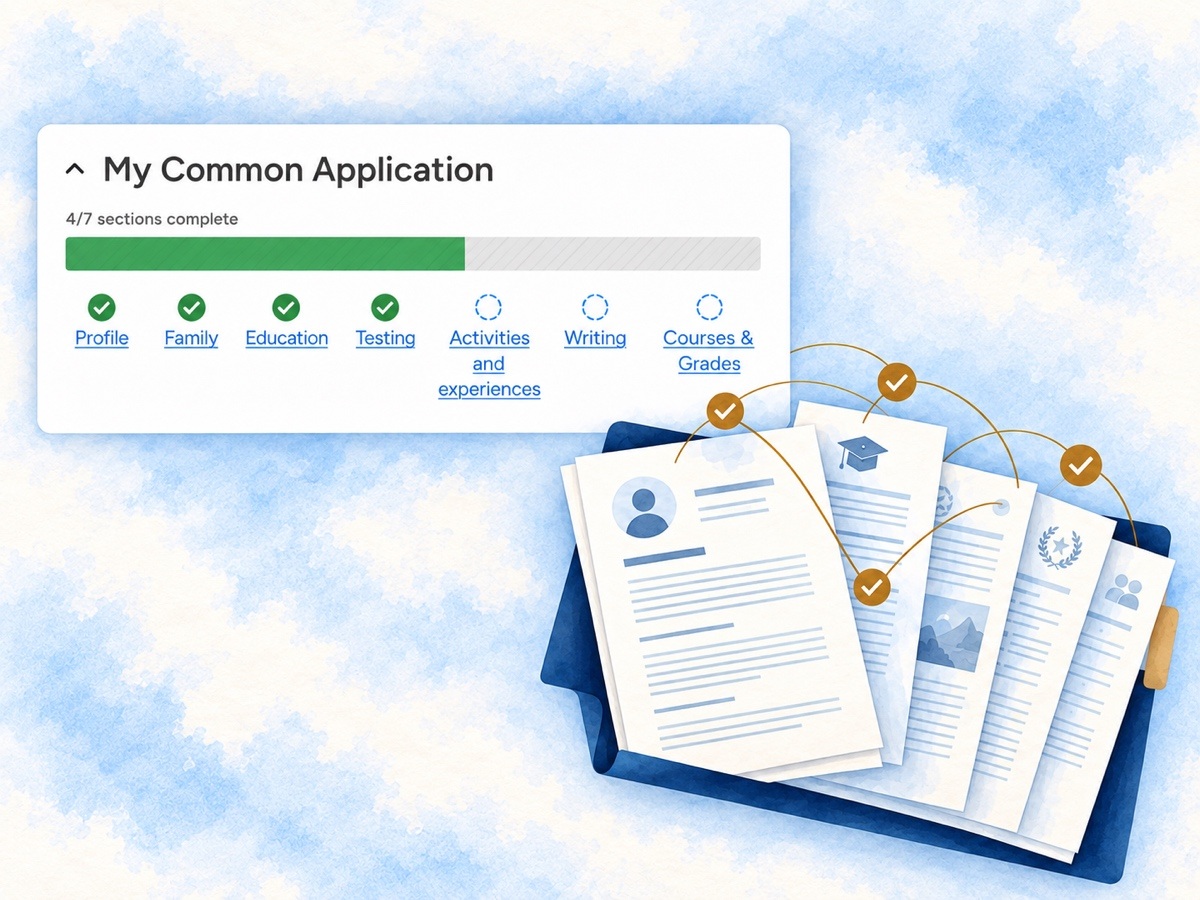
A student rarely writes an application in the order in which someone else will read it. They may begin with the activities section, work on the Common App essay over several weeks, and write the college supplements much later. The intended major can change somewhere in between. One person comments on the essay, someone else looks at the activities, and the school handles its own documents.
This is normal. Common App itself divides the work into sections and gives each section a green tick when it is complete. By the time all the ticks appear, every part may have been read so many times that the family has stopped seeing the application as a whole. The admissions reader, of course, will see the whole file.
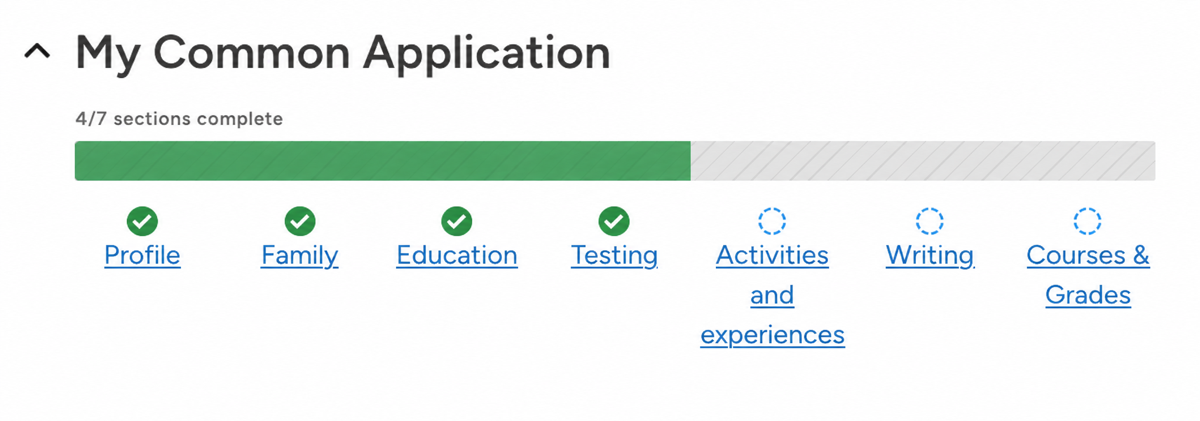
An illustrative progress view. The green checks confirm that sections are complete; they do not assess what the finished application says as a whole.
This is where I would pause before submission. Generate the application preview for one college and read it from the first page to the last without correcting sentences as you go. Very often, the problem that appears is larger than wording.
The intended major sounds central in the supplement, but nothing else helps the reader understand where it came from. The same achievement appears in the honours section, the first activity, the essay and Additional Information. Or the student sounds relaxed and specific in one answer, then strangely adult in the next.
After a full read, several reasonably good pieces can still leave the reader unsure about the student.
When I say that an application should hold together, I mean something quite limited: a claim made in one section should remain believable after the reader has seen the other sections. The application can contain several interests, and every activity does not have to support the intended major.
How the application gets read
I would be careful about generalising from one university’s process to every US college. Still, colleges ask for several kinds of material because each tells them something different.
In this episode on reading applications, Yale admissions officers describe reading the file cover to cover. They discuss how the picture of a student develops across the transcript, essays, teacher and counsellor recommendations, and activities. Yale also explains that it reads the transcript in the context of the school, using the school report, school profile and the opportunities available to the student.
For an Indian applicant, that context can matter quite a lot. A reader may be looking at CBSE, ISC, IB or A Levels. They may have internal marks, predicted grades and board results in front of them. One school offers twenty named leadership positions; another offers very few. Subject combinations that look like a free choice in the US may not have been available to the student at all.
The different parts of the file should help the reader make sense of this. When they pull in different directions and nobody explains why, they create another problem for the reader to solve.
Does every activity need to support the intended major?
Parents ask us this fairly often. My answer is no.
A student interested in economics may also play the tabla, debate seriously and help in a family business. I would not turn the tabla into evidence of economics. Debate does not have to become “economic policy advocacy.” The family business should be connected to the academic interest only if that is how the interest actually developed.
There should be some basis for the student’s interest in economics. It may come through school subjects, reading, a project, work done outside class or the questions the student raises in an essay. The rest of the application is allowed to show other parts of the student’s life.
I become concerned when the major itself does not seem to belong to the student. Suppose a student chooses computer science late in Class 11 because it appears to be a sensible option for the college list. Most of the student’s time has gone into debate, school leadership and community service. That does not disqualify the student from computer science. But if the supplement now claims a lifelong interest in building artificial-intelligence systems, I would want to know what supports that statement.
There may be a perfectly reasonable answer. Perhaps a recent class, book or piece of work changed the student’s direction. Then say that. A late interest is not a weakness that needs to be disguised as a childhood calling.
Trouble starts when unrelated activities are renamed to make the new direction look older and more settled than it is. At that point, I start doubting the application because I can see it being rearranged around a major chosen much later.
What becomes visible in a full read
The intended major is one common source of trouble. A student drafted the activities and Common App essay with one direction in mind, then changed the major and wrote new supplements. Each decision may be defensible. The completed application never explains how the student moved from one to the other.
The full read also shows repetition. A strong achievement gets used everywhere because the student does not want the reader to miss it. By the fourth appearance, valuable space has been spent without adding much. Yale’s discussion of Additional Information is useful on this point. The space can explain a circumstance or clarify something that may be misunderstood elsewhere. It is usually a poor place for another essay or a longer résumé.
Some applications have the opposite problem. An important piece of context appears nowhere. The school may restrict a subject combination, mark unusually harshly, or offer very few clubs and formal positions. A student may have a serious responsibility at home that explains the available time for activities. Depending on the information, it may belong in the school material or in Additional Information. Leaving it out means the reader has to interpret the record without it.
Changes in voice are especially easy to notice in the full file. I have seen applications where the 150-character activity descriptions sound like the student, the essay sounds like an adult, and the university supplement sounds like a brochure. Some variation is natural because the student is answering different questions. If the reader starts wondering who wrote each part, it has gone too far.
I would remove claims the student cannot comfortably defend and phrases they would never use in conversation. I would not make every answer equally polished simply for the sake of consistency.
Too many editors can create this problem
Families often try to improve a nearly finished application by showing it to several people. One person strengthens the essay opening. Another adds impressive language to the activities. A third rewrites the university supplement.
Each suggestion can sound sensible when considered separately. Once they are all accepted, the application may no longer sound as though one student wrote it.
Feedback is helpful when it shows the student where a reader became confused, where a claim is unsupported or where context is missing. I become more cautious when the feedback starts constructing a cleaner, more marketable version of the child. The student has to decide what stays. Otherwise, the final application can contain excellent sentences that do not belong together.
Read first, then edit
Take the application preview for one college and read it in one sitting. Do not begin rewriting on page one. Mark anything that feels confusing, repeated or out of character and continue to the end.
Afterwards, write three or four sentences describing the student you have just met. Then look at the application again:
- What does the academic record suggest the student is prepared to study?
- Which commitments appear to have taken sustained time or responsibility?
- What does the essay add that was not already visible elsewhere?
- What would an unfamiliar reader be most likely to misunderstand?
The student should do this first. Then ask one other person to read the same preview. Choose someone who knows the student but has not edited every section already. Ask them to describe the student before offering line edits.
If the two descriptions are reasonably close, the application probably needs a normal final review. If they are far apart, find out why. There is little value in polishing a sentence when the larger claim it supports is unclear.
The student cannot conduct the same review of confidential recommendations. Common App explains that counsellors submit school forms and transcripts, while teachers provide their own evaluations. The student can make the requests, check the requirements for each college and monitor whether the documents have been submitted. They should not try to script what a teacher says.
I would fix the things that change interpretation first. An unexplained academic choice matters more than a weak adjective. A generic response about the intended major deserves attention before two activity descriptions that begin with the same verb. If the essay no longer sounds like the student, another round of polishing will probably make matters worse.
Last week’s readiness review asked whether a particular college application should go in the early round. This full read is part of answering that question. Before submitting, the student should still recognise the person described across all those completed sections.