



When we were going through college admissions with our daughter a few years back, I remember seeing lots of programmes with Harvard, IIT or whichever university you aspired to in the title. So when parents now send me school circulars promoting programmes with these names, my antennae go up.
The name gets our attention. When the school is passing it on as well, that is another reason to take it seriously. There’s also a sense of FOMO. But before deciding whether it is worth the money, you should find out who is actually running it and what the child has to do to get a place.
In the first post in this series, we looked at the bill. This time, I want to look more closely at what is being sold. The distinction applies to summer schools, but also to competitions and the many short courses that reach families through school groups.
My advice on these programmes is fairly straightforward:
- A famous name is not enough reason to enrol. Find out who runs it and what your child will actually do.
- The experience can still be worth paying for. Travel, independence and meeting other students have value. Choose it because your family wants that experience, with realistic expectations about the learning.
- Compare alternatives before paying the premium. Less expensive, less famous options can offer better teaching or a more demanding academic experience. Selectivity is worth examining separately; it does not guarantee good teaching.
- Don’t buy it mainly for an assumed admissions advantage. A genuine university certificate still needs to be evaluated on what the student learns and produces.
- You can decide to skip it. A school forward or another child’s enrolment does not make it necessary for yours.
A programme at Harvard can be run by somebody else
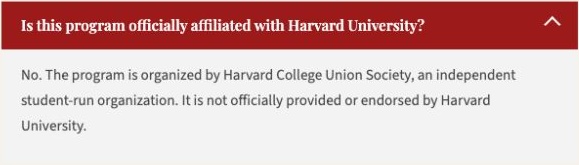
The Harvard College Union Society Young Global Leaders Summer Camp is a useful example. Its page advertises a camp at Harvard, with Harvard student mentors. Its FAQ also states that the organiser is an independent student-run organisation and that Harvard University does not provide or endorse the programme. Learn with Leaders supports it as a partner platform.

The same page lists accommodation at the Cambria Hotel Boston Somerville (note: not at Harvard campus). Possible outings include campus tours, bowling, a museum visit and a sporting event; these are described as tentative. It also describes workshops and group projects.
You should evaluate it as a camp run by a student organisation, with workshops and a travel component. An offer from it is not acceptance to a Harvard programme.
The student mentors may be good, and your child may enjoy the camp. But you must ask for more detail about the teaching before deciding whether the price makes sense. The Harvard name alone cannot answer that.
The IIT name needs the same reading
For an Indian example, look at this 2026 Power BI workshop listing for the National Skill Championship. The provider describes it as a MakeIntern and E-Cell, IIT Delhi initiative. Training takes place at a school, with evaluation to select five students for a finale at IIT Delhi. Participation and merit certificates are described separately.
If you receive this as an “IIT programme”, look at those details. The school workshop and the campus finale are different stages. The E-Cell collaboration is described by the provider; the listing does not establish that an IIT academic department runs the course.
There can be worthwhile learning in such a workshop, and qualifying for its finale can involve competition. A parent still needs to distinguish paying to attend the workshop from earning a place in the later round.
Compare that with IIT Delhi’s own announcement for its 2025 Change Makers bootcamp. Here the institute itself announced the programme and gave an academic-outreach contact, so we know who took responsibility for it. You should still check how students were selected. This is a past programme, from 2025; it is an example of what to look for in an announcement.
Registration and achievement are different things
This becomes particularly important with competitions. Parents sometimes ask whether a named competition is “good”. First, ask what your child is considering doing: registering, submitting work, qualifying for a later round or competing for a prize?
The Harvard Crimson Global Case Competition lists The Harvard Crimson and Crimson Education among its partners. Its site describes accessible entry with no prior business or economics experience required, followed by case-solving and competitive rounds. The university name in the competition title does not mean Harvard University runs the competition.
Entering gives a student a chance to try case-solving. If they qualify for a later round, that is an achievement we can describe separately. Calling both students “selected” for a Harvard competition would lose a fairly important distinction.
Likewise, the HUSO India page describes a tournament run by Harvard College and MIT undergraduates, with Learn with Leaders involved in India. That is the connection to those institutions. Look at the actual problems and competition rules to decide whether it would be a worthwhile challenge for your child.
Is the timetable mostly a trip?
I understand why a teenager might enjoy travelling with other students, seeing a campus and spending some time away from home. I have no objection to a family paying for that experience. You should be more careful if you are paying mainly because you expect it to strengthen a college application.
If most of a programme’s timetable is sightseeing and general activities, with a few talks fitted around them, treat it as an educational trip when deciding what to spend. It could be an expensive sightseeing trip with some teaching included, and the family should see the schedule before paying for it as a serious academic course.
But do not reach that conclusion just because an itinerary includes a museum or a free afternoon. Check the teaching hours and assignments before dismissing a programme as “nothing but tourism”. The camp described earlier advertises academic activities as well as outings; its page alone does not establish the quality of either.
Ask for a sample day and a sample piece of student work. How long are the taught sessions? Who teaches them? What must the student prepare, and who reads or critiques what they produce? A detailed answer helps much more than another photograph of the campus.
For a research course, ask what role your child will have in the investigation. For a coding course, ask what they will build and how it will be reviewed. “Exposure” may be a reasonable goal for a beginner, but the family should know that is what it is buying.
Give real selection more weight
If a student wants a serious academic challenge, you should generally give more weight to a programme that assesses their readiness and then requires substantial work. A famous venue carries much less weight in my recommendation.
Consider Research Science Initiative India. Its current announcement describes 32 places, assessment by a CEE and IISc committee, and applications containing personal statements, STEM achievements, recommendations and school records. Selected students undertake individual research with IISc mentors and present a paper and a talk.
The published 2027 eligibility is specific: Indian citizens studying in India, currently in Class XI when applying and having completed that class by the programme. It is therefore not an option to suggest casually to every Class 9 or 10 family. The programme covers participation, room and board; travel and medical insurance remain the family’s responsibility.
This gives me something useful to judge: the organisers assess academic preparation, and the students then have to do research and present it. I can explain why I recommend applying to a student who is ready for that work.
Still, do not turn selectivity into another prestige contest. Thirty-two places tells us the cohort size, not an acceptance rate. Without an applicant count, we cannot calculate one. And a programme that is difficult to enter can still be unsuitable for your child’s interests or current preparation.
A well-taught open course may be the better choice for a student starting a subject. If that is what your child needs, choose it for the teaching. There is no reason to dress up the registration as a competitive achievement.
What you should check before paying
Even if the university confirms that it is involved, keep asking questions. A genuine university certificate may come with a short introductory course. That can be useful, but you should still find out how much teaching and individual attention the fee buys.
Ask the organiser or find out a few things:
- The university’s role. Does its own website list the programme? Which school or department is responsible, and what does the outside provider handle?
- The actual teaching hours. How many hours are live classes, and how much is independent work? “Three weeks” tells you very little if the classes meet only a few times. Which of the advertised instructors will teach this particular cohort?
- The feedback your child will receive. Who reviews their work, how often, and is any of that feedback individual? A final project sounds promising, but ask to see an example and find out how much of the work the student does themselves.
- What makes admission selective. What is assessed, who assesses it, and what would lead to an applicant being turned down? A small cohort may simply mean a small class. “Limited places” does not tell us how difficult it is to get one.
- What the certificate confirms. Who issues it, and is it for attendance or assessed work? Does the course carry academic credit? If the provider claims that universities value it, ask what evidence supports that claim.
- The full price and terms for this intake. What is included, what costs extra, and what happens if the student withdraws? Compare that fee with the teaching and feedback on offer before deciding whether it makes sense for your child.
My advice is to be quite skeptical of paying a premium for the university name. Your child may enjoy the programme, learn something useful and come back more confident. Those are reasonable reasons to consider it, provided the experience is worth the cost to your family. But before paying, compare it with less famous options where the teaching may be better, the work more demanding, or admission genuinely competitive. And if your main reason is that the certificate will look impressive in a college application, I think you should reconsider. You need a better reason to spend that money.
In the next post, we will look at what any of this means in a college application. Even a genuine university programme needs to be described with some care when the family’s main expectation is an admissions advantage.
Have an essay draft you’re unsure about?
Our College Essay Idea & Structure Review offers another set of eyes on a Common App personal statement or complete UCAS statement. We review the idea, evidence and structure, speak with the student, and give written next steps. The student does the revising. See what the review includes.
Follow the series
Subscribe to College Admissions Field Notes for the next posts. If you would like to discuss which opportunities make sense for your child, find out about an AltView Deep Session.
Share with other parents
If this was useful, please share it in your WhatsApp groups. You can copy the note below:
Sharing this for parents considering summer programmes or competitions. It explains what the Harvard or IIT name actually means, what to check before paying, and how to judge whether the learning is worth the cost. https://altviewedu.com/is-that-harvard-or-iit-programme-worth-your-money/